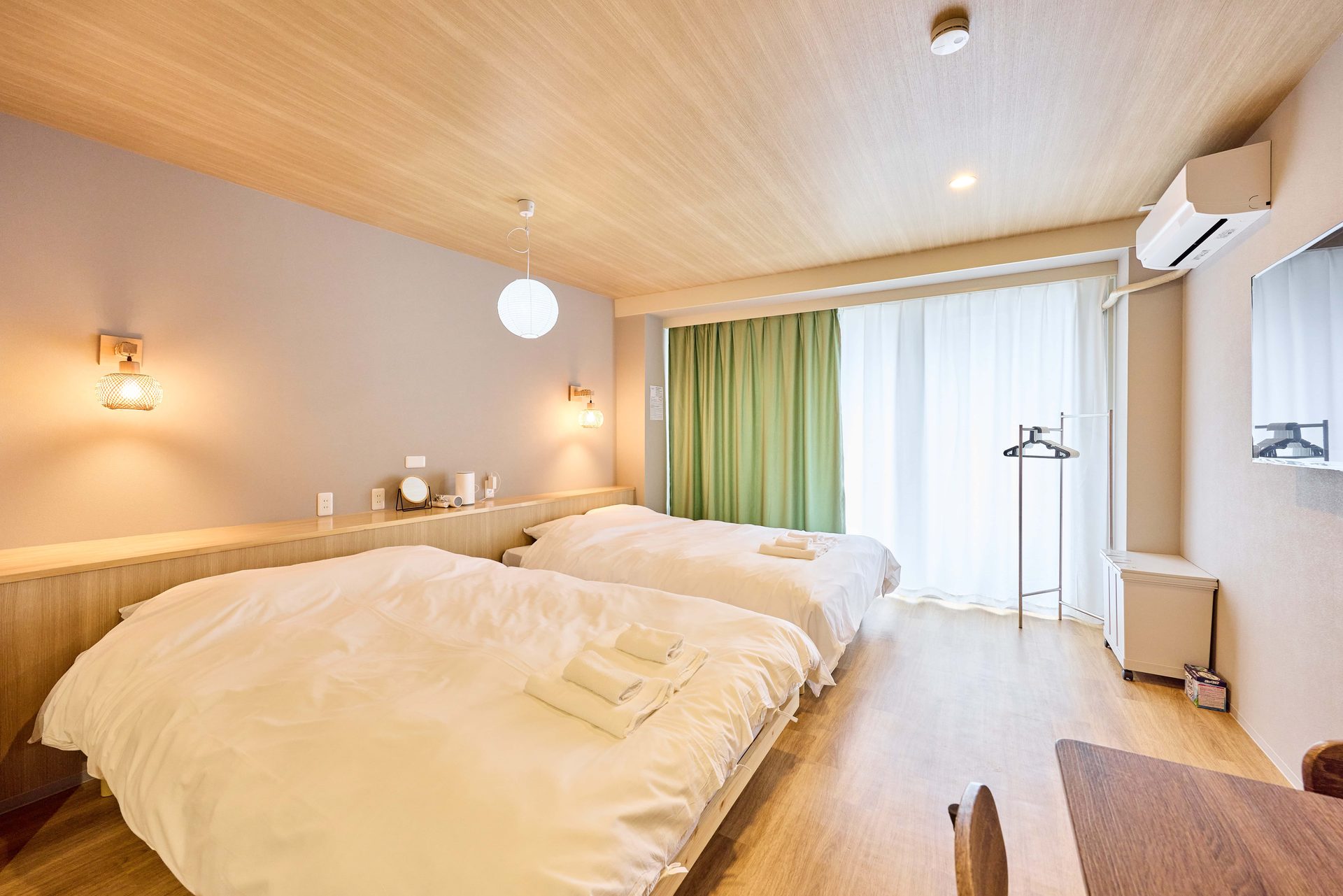
Traveling to Osaka as a group, how do I choose between a whole-house rental and several hotel rooms?
Start with a question that has nothing to do with price: does your group actually want to be together on this trip. If you only read one paragraph, this is the one.
This question sounds soft, but it's actually the hardest dividing line in the whole decision. That's because a hotel and a whole-house rental aren't selling the same product at all:
- A hotel sells "a room." Its product is designed on the premise that strangers each stay one night. Rooms are separated by a hallway; to find someone else in your group you have to put your shoes on and knock. That's not a flaw — it's built for "not disturbing each other," and it does that very well.
- A whole-house rental sells "everything beyond the room." Living room, kitchen, dining table, balcony — what you're paying for is the whole building, including spaces that usually don't exist at a hotel, or that you'd have to share with strangers.
And the moments where "traveling together" actually happens on a trip almost all take place in the latter: gathering around the table before heading out to divide up who carries what, spreading out in the living room afterward to look at the day's photos, a kid playing on the floor while the adults chat nearby. If none of that matters to your group, you won't use what a whole-house rental sells, and no price is cheap enough to make it worthwhile.
So the right question isn't "which is cheaper," it's "what kind of group are we."
| What your group looks like | Better fit | Why |
|---|---|---|
| Only meets up at the end of the day; everyone's out and eating separately during the day | Hotel | Shared space sits empty all day — you're paying for time you don't use |
| A quick two-day, one-night trip, or an overnight layover | Hotel | A whole-house rental's value comes from time together, and there's too little time to build up |
| Three generations traveling together, with both elders and young children | Whole house | Schedules diverge a lot, and what's needed is "separate doors within the same building," not three doors on the same hallway |
| Friends traveling together, wanting to keep talking into the night | Whole house | A hotel room has nowhere to sit, so everyone ends up crammed on the edge of a bed |
| Staying 4+ nights, wanting to cook and do laundry | Whole house | A kitchen and laundry equipment only pay off with a long enough stay; a short stay can't make use of them |
| Needs daily housekeeping, a 24-hour front desk, late-night luggage storage | Hotel | These are standardized services that a minpaku mostly doesn't provide |
This table deliberately lists "hotel" three times. If your group falls into one of those three rows, this page's advice is to book a hotel — being clear about the cases where it isn't a fit is more useful than saying every case fits.
Why is "which is cheaper" the wrong question?
Because most people compare "the price of the whole house" against "the price of one room," and those were never the same product. There's only one correct comparison: convert both sides to per person, per night, then add back what each side leaves out.
Step one is simple, write out both formulas:
- Hotel side: (price per room × number of rooms needed × nights) ÷ headcount ÷ nights
- Whole-house side: (total price for the whole house) ÷ headcount ÷ nights
Just filling in "number of rooms needed" honestly flips a lot of people's gut instinct — a group was never going to fit in one room. But what really decides the answer is step two: both sides have a pile of costs that never show up in the room rate.
| Easy to leave out when booking several hotel rooms | Easy to leave out when renting a whole house |
|---|---|
| The number of rooms itself. A group often needs 3 rooms when 2 isn't enough, but what sticks in people's heads is "the price of one room." | Grocery costs. Cooking is genuinely cheaper than eating out every meal, but it's not zero. The first day's shopping trip is usually a noticeable expense. |
| Breakfast. Budget hotels mostly charge separately, and a group eating breakfast out every day adds up over several days. | Transit. A whole-house listing usually isn't right in the busiest part of town, so some itineraries mean a few extra stops or minutes. |
| Laundry. Coin laundry, a laundry service, or the checked-baggage fee from packing an extra suitcase just to avoid doing laundry. | Physical effort. Luggage has to be carried in and out yourselves. That's not money, but it's a cost — mention your luggage situation when booking, and we can help arrange the room type with the easiest access. |
| Extra beds and cribs. Usually charged separately, and often limited by room type — not something you can just add. | No daily housekeeping. You maintain the space yourself, and sort the trash by local rules yourself. |
| The cost of "wanting to gather." If the room can't fit everyone, you end up at a restaurant or café — which is still spending. | Minimum nights. Osaka's special-zone minpaku rule sets a statutory minimum stay period, so a short stay may not even be an option here (details below). |
| Time spent getting everyone together. Split across different rooms or units, the time it takes to assemble before heading out gets longer. | Splitting the bill. A whole house is one lump sum, and you'll need to divide it among everyone afterward — best to agree on how before you leave. |
Once you've added up both columns, you get two numbers you can actually put side by side. We deliberately don't fill in any amount on this page — not to be coy, but because room rates change with date, headcount and season, and any number we hardcoded on the site could become inaccurate the next day. Asking the official LINE directly for the actual amount on a specific date is the fastest way to find out, and the only accurate one.
If you want to see how much "a whole house" and "three rooms" actually differ visually, we filmed a video that does exactly this comparison: Whole House vs. Three Rooms. What text can't convey about the sense of space, that video covers in a minute.
How many people, how many nights, before a whole-house rental is actually worth it?
Rather than fixing a headcount threshold, answer an easier question first: if you weren't renting a whole house, how many rooms would you actually book?
This question works better than "how many people" because it already accounts for group composition, gender, generation and whether kids are involved. Four adults might be two rooms, or it might be three; six people with a child are often still three rooms. How many rooms you'd actually book is far more honest than the headcount alone.
- The answer is 1 room: a whole-house rental almost never makes sense. You'd be paying for space you don't use.
- The answer is 2 rooms: it depends on whether you value shared space. If you're just trying to save a little, you usually won't; if you want somewhere to sit together, then it's worthwhile.
- The answer is 3+ rooms: worth seriously running the numbers. At this scale, everything the hotel side leaves out scales up together — breakfast for three rooms, extra beds for three rooms, three sets of scattered luggage.
The logic on the nights side is different — it's about how fast things pay off:
- 1 night: in Osaka, this usually isn't even an option. A special-zone minpaku has a statutory minimum stay period (detailed in the next section); Shinsai Wings' minimum stay is 2 nights.
- 2–3 nights: shared space starts to pay off. You'll use the dining table and living room, but the kitchen will probably only get a serious workout once.
- 4+ nights: this is the real sweet spot for a whole-house rental. After three days of eating out, a pot of something home-cooked beats any famous restaurant; luggage can stay spread out instead of packed away; clothes can be washed, so your suitcase can be a size smaller.
- A month or longer: that's a different way of staying altogether — the terms and how to ask are laid out on the Osaka Monthly Stay page; the hardware and room types are identical, the only difference is length of stay and price.
On the capacity limit, we only state one verified number: the whole house at Shinsai Wings holds up to 16 people. We won't tell you "how many people per room type" — we don't have a verified figure for that, and we'd rather leave it blank than hand you a derived number that only looks right. For actual room assignments, ask directly — telling us your group's composition gets you a far better answer than guessing.
Shinsai Wings — Verified Facts
- The whole house holds up to 16 people — the one number worth confirming first for "whole house vs. several rooms"
- Four room types, each a fully independent whole unit (Room A, B, C and D; Room D is a loft): renting the whole house means renting four separate independent units, each with its own bathroom, kitchen and dining area
- Every room type has a private bathroom, and all include a bathtub — the reason a group doesn't have to queue in the morning
- Check-in 16:00 / check-out 10:00; minimum stay 2 nights; not set up for pets
- 📌 This box only lists facts directly relevant to "should we rent the whole house." The full list covering building structure, each room type's hardware, licensing and transit routes is in "About Shinsai Wings."
What does a whole-house rental actually buy you? And what does a hotel buy you?
In one line: a whole-house rental buys "flexibility and togetherness"; a hotel buys "standardization and convenience." Neither is better — only better suited.
Articles about whole-house rentals online rarely give hotels credit, and that's dishonest. There are three things a hotel does that a whole-house rental almost can't:
- Daily housekeeping. You go out in the morning, come back to a tidy room in the evening. For some people that's the core of a trip, not a nice-to-have.
- A 24-hour front desk. A delayed flight at 3am, a key problem, needing to store luggage — someone's always there.
- Predictability. A chain hotel room looks exactly as you'd expect with your eyes closed — no surprises, but no shocks either.
A whole-house rental gives you three other things instead:
- A kitchen you can actually cook in. The words "kitchen included" on a listing page carry very different weight — some are a microwave and a small sink against the wall, others are a real stovetop you can cook a meal on. The difference becomes very obvious after day three, and for families with infants it's directly tied to whether you can make baby food fresh (the full checklist for traveling with young kids is at Osaka Family Stay Guide).
- Schedules that don't have to accommodate each other. Someone up at six for a jog, someone getting back at 2am — at a hotel that's a hallway noise complaint; in a building where every room type is fully independent, it's just different units living their own lives.
- Chinese communication, start to finish. Shinsai Wings is run directly by Taiwanese hosts — questions before or after booking go to the official LINE, no translation layer and no waiting on a platform's messaging system. In a place where the language is unfamiliar, that's often more useful than a 24-hour front desk. It's also the one thing we're willing to guarantee — ask in Chinese, and someone will answer you in Chinese.
One more commonly misunderstood point deserves its own mention: "a whole-house rental only pays off with a lot of people" isn't entirely true. Headcount does matter, but a three-generation family of just six or seven people needs "elders undisturbed, kids with room to run, adults with somewhere to sit and talk" all at once — a hotel almost can't deliver that. That's no longer a price question, it's a structural one. Price can be compared; structure can't.
When should you "not" rent a whole house?
In the four situations below, we'd tell you to book a hotel ourselves. This section isn't here to look objective — these four situations are genuinely common.
- Staying just one night, or an overnight layover. A whole-house rental's value comes from time together, which one night isn't enough for; and in Osaka, the statutory minimum stay for a special-zone minpaku usually rules out "just one night" as an option anyway.
- The whole group goes its own way all day. If the only time you're under the same roof is while sleeping, shared space sits empty all day and you're paying for something you don't use.
- You really need daily housekeeping and a 24-hour front desk. A minpaku usually doesn't clean daily; Shinsai Wings has a washing machine and dryer available, but that's use of the equipment — you wash and dry your own clothes, and our service covers up to the equipment being available to use. Be clear on this distinction before booking.
- Your company expense report needs a specific type of receipt. We leave this one honestly blank: which receipts can be issued isn't on our list of confirmed facts, so this page makes no promises about it. If your trip needs to be expensed, ask directly before booking — don't infer it from this article.
Once you've decided to rent a whole house, how do you tell if a listing can actually fit a group?
Photos can mislead, but four fields mostly can't. When looking at any whole-house listing, go straight to these four — if you can't find them, ask directly; a vague answer usually tells you everything.
- Whether the bathroom is "shared across the whole house" or "private to each room type." Shinsai Wings has a private bathroom for every room type, and all include a bathtub; when looking at other whole-house listings, this is the most commonly missed item — a listing page usually makes the room count look large while the bathroom count stays buried in the details, and it's always the bathroom that becomes the bottleneck during that half hour a group is trying to leave in the morning.
- Whether it's "independent room-type units" or "one open floor with everyone on the same floor." Renting a whole house doesn't mean everyone sleeps on the same floor. Some listings advertised as a whole house are actually one open space with all the partitions removed — fun for a group of young friends, maybe, but a disaster with elders or young kids along. Shinsai Wings has four room types, A, B, C and D, each a fully independent whole unit (Room D is a loft with a multi-level layout).
- Whether there's a kitchen you can actually use, and a table to eat at. The dining area matters just as much: a kitchen with nowhere to sit together means food still gets carried back to separate rooms, which defeats the point of renting a whole house. Shinsai Wings has a full kitchen and its own dining area in every bookable room type.
- Which legal framework it operates under. This is the item fewest people check, yet it's the only one that can ruin your entire trip if something goes wrong. The next section covers this in full.
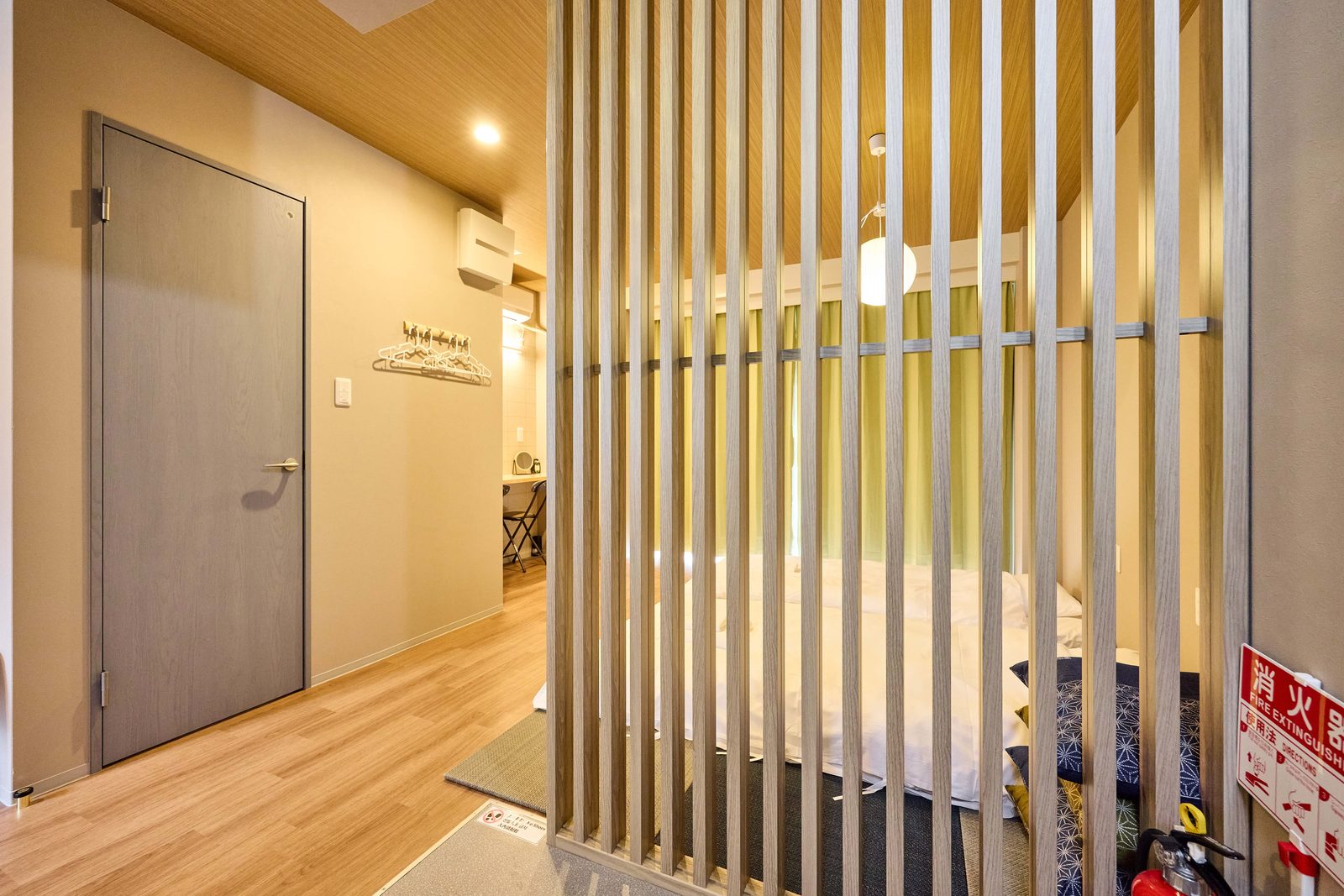
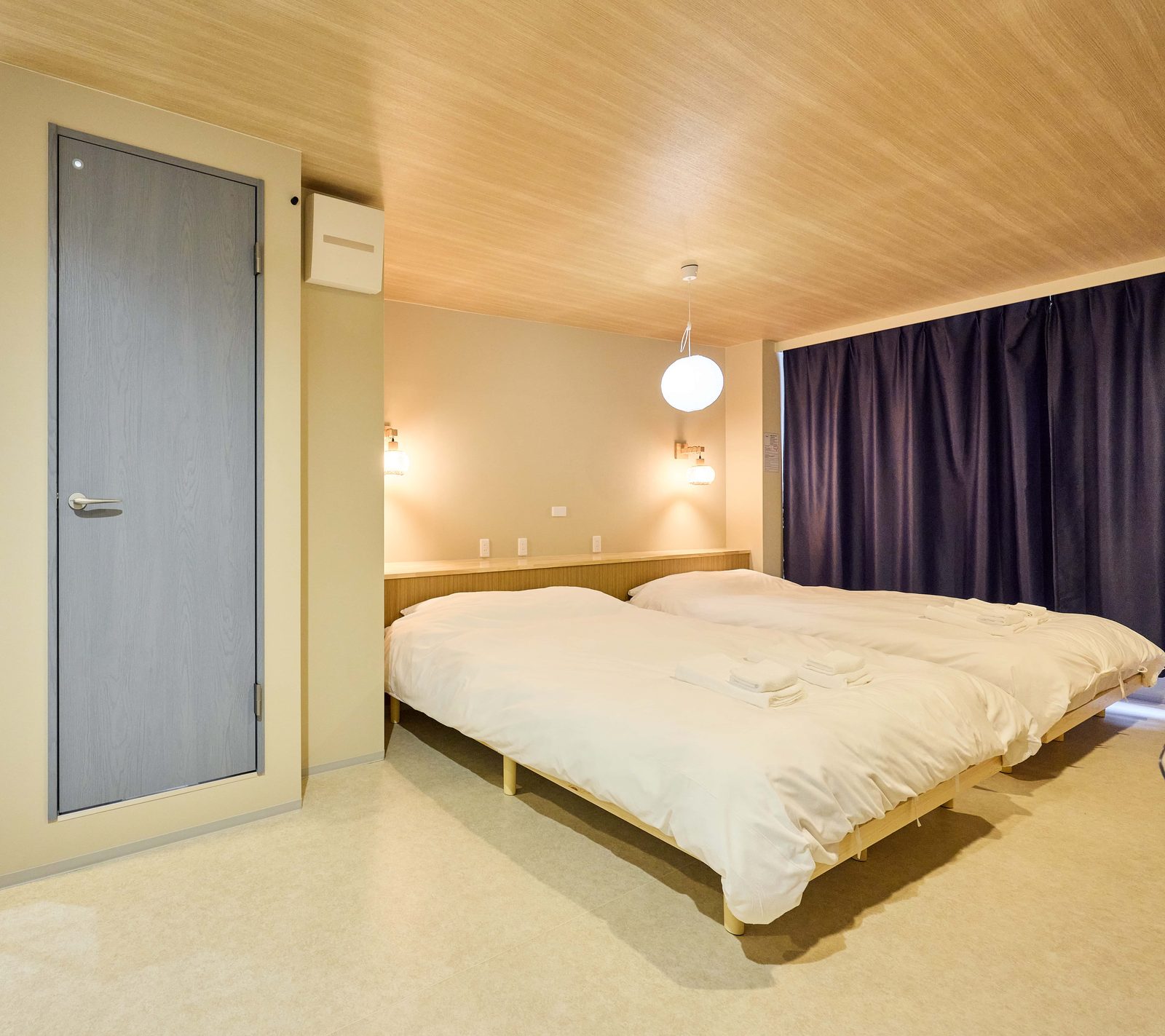
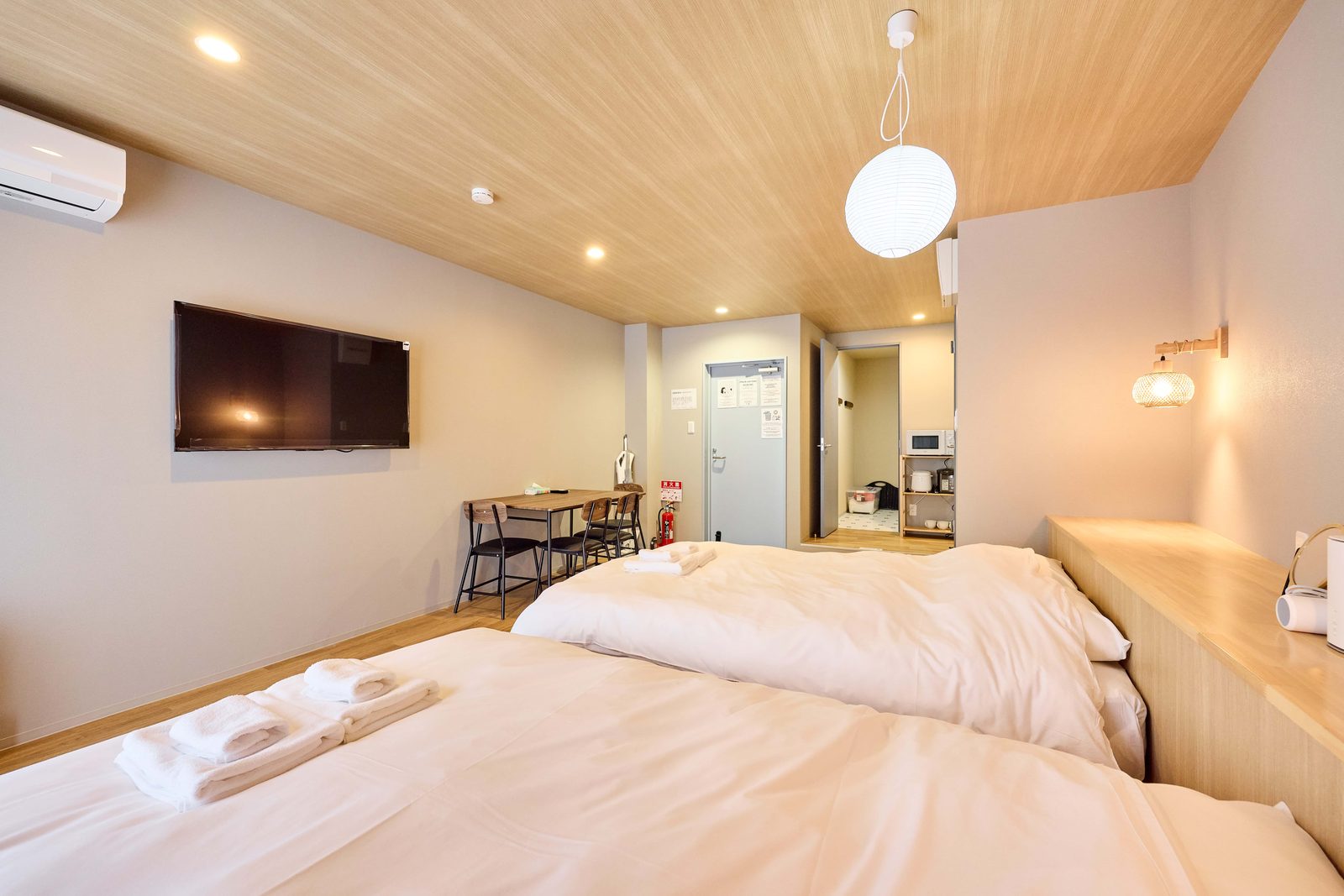
As for "once you've decided to rent the whole house, how do you split rooms and schedules" — who sleeps in which room type, when to shower, where to put elders — that's a separate topic, covered in full at How to Plan an Osaka Group Stay; we won't repeat it here.
How do you confirm a whole-house minpaku in Japan is operating legally?
First check which framework it operates under, then look on the listing page for the matching number. Lodging operation in Japan isn't a yes/no question of "is it registered" — it's three separate routes, each with its own rules:
| Framework | Basis | What matters most to a guest |
|---|---|---|
| Hotel Business Act license | The Hotel Business Act. Categories include hotel/ryokan operation, simple-lodging operation, and boarding-house operation. Simple-lodging operation refers to operations with "a structure and facilities where the lodging space is shared by multiple people." | No annual operating-day cap. Most hostels and minpaku-style lodging take this route. |
| Notification under the Private Lodging Business Act (minpaku shinpo) | The Private Lodging Business Act. Notification is filed with the prefectural governor or equivalent. | Annual operating-day cap of 180 days, and "one year" runs from noon April 1 to noon the following April 1, with "one day" running from noon to noon the next day. Some listings are closed for roughly half the year as a result. |
| Special-zone minpaku certification | A special exception to the Hotel Business Act under the National Strategic Special Zones Act, formally called the "National Strategic Special Zone Business for Accommodating Foreign Visitors." Under this framework, a person is allowed to use a facility for a set minimum period under a lease agreement and its related contracts, with services such as foreign-language usage guidance provided. | Can operate year-round, but has a statutory minimum use period — this is why many Osaka whole-house listings don't accept a single night. |
The "minimum use period" under the third route is written explicitly for Osaka: under Osaka City Ordinance No. 3 (concerning the National Strategic Special Zone Business for Accommodating Foreign Visitors), the facility's use period is set at 3 days (2 nights) or longer, and 1 night, 2 days is explicitly not allowed. So when you see a pile of Osaka whole-house listings all stating "minimum 2 nights," that's not the host picking guests — that's the ordinance.
That's the reason for Shinsai Wings' 2-night minimum stay. Room B, C and D are certified under Osaka's special-zone minpaku rule and can operate year-round under a licensed management company; Room A operates under Japan's general minpaku registration (an annual cap of 180 nights).
So how should a guest actually check this themselves?
Look on the booking platform's listing page for the number the platform is required to display. This is grounded in an actual rule, not something we made up: under the Japan Tourism Agency's "Preventing the Listing of Illegal Properties" policy, a mediation platform listing a notified property must first confirm the operator's name, the notified property's address, and its notification number, and may not list a property it can't confirm; and to let site visitors know a property is legitimate, the listing must display information including the notification number. The mediation platform itself must also be registered with the Commissioner of the Japan Tourism Agency.
In other words, that unassuming-looking number on the platform's listing page is the single most checkable link in the whole chain. Conversely, a listing that offers no framework information at all and won't answer "which route do you operate under" is giving you its own answer.
⚠️ On our own level of disclosure: we haven't put any notification/registration number on this website. A number displayed publicly has to be exact, character for character, and we'd rather leave it blank than publish an unverified string. What this page states is only what's already confirmed: Room B, C and D are certified under Osaka's special-zone minpaku rule, operated by a licensed management company; Room A operates under general minpaku registration. This is a deliberate choice to be conservative, not a data gap.
When a group moves into a whole house, what actually happens on day one?
Roughly this: arrive, put luggage away in each room type, go shopping, then plan tomorrow around the dining table. This section fills in the picture, because "a whole-house rental is great" carries no information — the actual sequence does.
Before arriving. The route from Kansai Airport to Taisho Ward needs a transfer; the route and how to make it are laid out in Kansai Airport to Taisho Station. When a group moves together, the thing worth deciding first isn't actually the route — it's who's responsible for the big luggage.
The first thing after check-in: splitting up by room type. Check-in is at 16:00. How rooms get split isn't just a matter of preference — tell us your group's makeup and luggage situation before booking, and we'll help arrange the room type with the easiest access (Room A has zero-effort luggage access). Anyone hoping to sleep on tatami should remember tatami comes with Room A and Room D only (see Osaka Tatami Room Stays). How to handle luggage itself, and whether to store it beforehand, is covered separately at Osaka Luggage Storage Guide.
The first night's shopping. This is the moment a whole-house rental differs most from a hotel. Because every room type has a full kitchen, someone usually volunteers on the first night to go buy tomorrow's breakfast, drinks, and a few things nobody planned to buy but couldn't resist. That self-made breakfast often becomes the meal the whole group remembers longest — not because it's delicious, but because it's the only meal everyone is present for at the same time.
The second morning. This is when the bathroom count reveals itself. Every room type having a private bathroom means each group washes up on its own, no queuing; wanting a bath at night, you don't have to wait for anyone either. It's one line on a listing page, and an entire chapter of life at eight in the morning.
Laundry day. This usually lands on day three or four. There's a washing machine and dryer to use, and you wash and put away your own clothes — our service covers up to "the equipment is available to use." But its real impact is significant: knowing you can do laundry means a smaller suitcase, and much easier moving in and out. How to plan laundry is covered separately at Does Osaka Accommodation Have a Washing Machine?
Going-out days. Shinsaibashi is the easiest leg: from Taisho Station on the Osaka Metro Nagahori Tsurumi-ryokuchi Line, 4 stops, about 6 minutes, ¥190, because Taisho is the terminus of that line, so boarding at the start needs no transfer. Universal Studios Japan requires a transfer to the JR Yumesaki Line (Sakurajima Line) at Nishikujo Station, 1 transfer for the whole trip, about 18–22 minutes depending on the train, ¥200 — the full route is one change at Nishikujo; the time is given as a range because it varies with the specific train. How to plan a group's USJ day is at USJ Stay Guide; if you're here for a concert, there's a separate Kyocera Dome Concert Stays guide. What Taisho Station itself connects to and what the area looks like is laid out in full at Taisho Station Area Guide.
Checkout. Checkout time is 10:00. A group checking out is more work than one person not because of the paperwork, but because "the whole house has to be tidied" — starting the night before goes a lot smoother than a scramble on checkout morning.
The transit information in this section — routes, number of transfers, ride time and fares — is all sourced. For the actual walking route from the property to the station, go by a map app's live result. That's this site's consistent approach: what's sourced, we state clearly; what isn't, we tell you what to go by instead.
More frequently asked questions
Traveling to Osaka as a group, how do I choose between a whole-house rental and several hotel rooms?
Start with a question that has nothing to do with price: does your group actually want to be together on this trip. If everyone goes their own way all day and only meets back at the room to sleep, a hotel is more efficient; if you'll eat breakfast together, pack together, and want to sit and talk in the evening, what you want is "space beyond the bedroom" — that's exactly what whole-house rental sells, and a hotel doesn't.
Bringing parents and kids, 10 people total, planning a Universal Studios Japan day — several hotel rooms or a whole house?
For 10 people staying two nights or more who'll eat meals together, a whole-house rental fits better: Shinsai Wings is a 5-story steel-frame standalone building in Taisho Ward, Osaka, and Room A, B, C and D each have a private bathroom with a bathtub and a full kitchen, so four groups can each use their own bathroom. From JR Taisho Station to Universal Studios Japan is 1 transfer at Nishikujo, about 18–22 minutes depending on the train, ¥200; the whole house holds up to 16 people — tell the official LINE @040fyjwd your dates and headcount and we'll check availability for the whole house.
Is a whole-house rental always more expensive than a hotel?
Comparing the price of a whole house against the price of one room is of course more expensive, but that's not the same product. The correct comparison converts both sides to "per person, per night," then adds back what each side leaves out: the hotel side commonly leaves out the extra rooms you actually need, breakfast, coin laundry, extra beds, and the restaurant you'll need when you want to gather; the whole-house side commonly leaves out grocery costs, the effort of carrying your own luggage in and out, and the absence of daily housekeeping. Shinsai Wings doesn't post prices on this website — ask the official LINE for the actual amount.
How many people does it take for a whole-house rental to make sense?
Rather than fixing a headcount threshold, work out how many rooms you'd actually book if you weren't renting a whole house. If the answer is 1 room, a whole-house rental almost never makes sense; if it's 2 rooms, it depends on whether you value shared space; if it's 3 or more rooms, it's worth seriously comparing. The whole house at Shinsai Wings holds up to 16 people.
Can I rent a whole house for just one night?
In Osaka, mostly not. Under Osaka City Ordinance No. 3, the facility-use period for a special-zone minpaku must be 3 days (2 nights) or longer, and 1 night, 2 days is not available. Shinsai Wings' minimum stay is 2 nights. And a whole-house rental's value comes from time spent together, which one night usually isn't enough to make use of.
How do I confirm a Japanese minpaku property is operating legally?
Start by checking which framework it operates under: a Hotel Business Act license (hotel/ryokan operation, simple-lodging operation, or boarding-house operation), a notification under the Private Lodging Business Act (minpaku shinpo), or a special-zone minpaku certification under the National Strategic Special Zones Act. A property under the Private Lodging Business Act has an annual cap of 180 days; and under Japan Tourism Agency rules, a mediation platform listing a notified property must confirm and display information including its notification number. So the most practical step is to look on the booking platform's own listing page for that number, which the platform is required to display.
Does every room type in a whole-house rental have its own kitchen and bathroom?
At Shinsai Wings, every room type is a fully independent whole unit, each with a private bathroom, and all include a bathtub; every bookable room type has a full kitchen and its own dining area. Tatami bedroom: only Room A and Room D have one. Large balcony: comes with Room B, C and D.
Is a whole-house rental convenient for reaching Universal Studios Japan and Shinsaibashi?
Shinsaibashi is direct: from Taisho Station on the Osaka Metro Nagahori Tsurumi-ryokuchi Line, 4 stops, about 6 minutes, ¥190, because Taisho is the terminus of that line. Universal Studios Japan needs a transfer to the JR Yumesaki Line at Nishikujo Station — 1 transfer for the whole trip, about 18–22 minutes depending on the train, ¥200, with that one change made at Nishikujo.
Can I do laundry with a whole-house rental?
Yes, there's a washing machine and dryer, and nightly-stay guests can use them too. This is use of the equipment, and our service covers up to the equipment being available to use — you wash, dry and fold your own clothes. For a group staying four nights or more, this often directly decides whether you bring an extra suitcase.
Planning to stay more than a month — can I still rent the whole house?
Yes, every room type can also be booked as a longer-term rental — the hardware, room type and function are identical to a nightly stay, the only difference is length of stay and price. The terms and how to ask about a stay of a month or more are laid out at Osaka Long Stay Overview, and the situation for students is covered separately at Osaka Student Short Stay. Actual amounts are always by direct message.
What official sources does this article cite?
All listed here, and each was confirmed by actually opening the page on 2026-08-25 before it was written into the article. If you find any of these no longer matches the current page, the official page always takes precedence.
- Ministry of Land, Infrastructure, Transport and Tourism / Japan Tourism Agency, minpaku system portal, "What is the Private Lodging Business Act (minpaku shinpo)?" — annual operating-day cap of 180 days, one year starting at noon April 1: mlit.go.jp
- Same source, "About the Hotel Business Act" — categories of hotel operation (hotel/ryokan operation / simple-lodging operation / boarding-house operation) and the definition of simple-lodging operation: mlit.go.jp
- Same source, "About Special-Zone Minpaku" — special-zone minpaku as a special exception to the Hotel Business Act under the National Strategic Special Zones Act: mlit.go.jp
- Same source, "Preventing the Listing of Illegal Properties" — mediation platforms must confirm and display the notification number, and may not list what they can't confirm: mlit.go.jp
- City of Osaka, "On the Minimum Number of Lodging Days for Special-Zone Minpaku" — 3 days (2 nights) or longer, 1 night 2 days not allowed: city.osaka.lg.jp
- City of Osaka, "Osaka City National Strategic Special Zone Business for Accommodating Foreign Visitors (Special-Zone Minpaku)": city.osaka.lg.jp
- Osaka Metro, "Boarding / Commuter Fares (Subway / Osaka City Bus)" — subway standard fare zone table: subway.osakametro.co.jp
- Osaka Metro, Taisho Station (Nagahori Tsurumi-ryokuchi Line N11) station information: subway.osakametro.co.jp
- JR West "JR Odekake Net," Taisho Station station information: eki.jr-odekake.net
📌 The information in this article is sourced only from our own records and official sources.
⚠️ The correct way to check the following six items is listed here as well: ① room rate and per-person-per-night amount — go by the price shown on the room's own Airbnb page and the official LINE's reply at the time; ② room size — judge from the photos on this page and the actual space on site; ③ headcount by individual room type — the only figure this site has verified is 16 for the whole house; tell the host your headcount for individual arrangements; ④ the walking route from the property to the station — go by a map app's live result; ⑤ notification number / registration number — go by the registration on file with the relevant authority; ⑥ expense receipts — ask the host via official LINE for the current arrangement. Ask about these six items directly; the answer follows the sources above.
Still deciding between a whole-house rental and a hotel? Tell us your headcount, number of nights, whether you have elders or young kids, and whether you want to cook, and we'll give advice based on your group's actual situation — if a hotel is the better fit, we'll say so directly. Tap "Free help booking your Osaka stay" at the bottom right to ask the host directly, official LINE: @040fyjwd, run directly by Taiwanese hosts, communicating in Chinese with no barrier.
Is your group staying together for a few nights, or is it just you staying a month or more?
Same building, same hardware, two ways to stay: a group renting the whole house (up to 16 people), or one person on a monthly long stay (from one month). Click through for the facts table, room-assignment logic, and how to ask about availability.
Still deciding? Add us on Official LINE @040fyjwd and tell us your move-in month and length of stay.