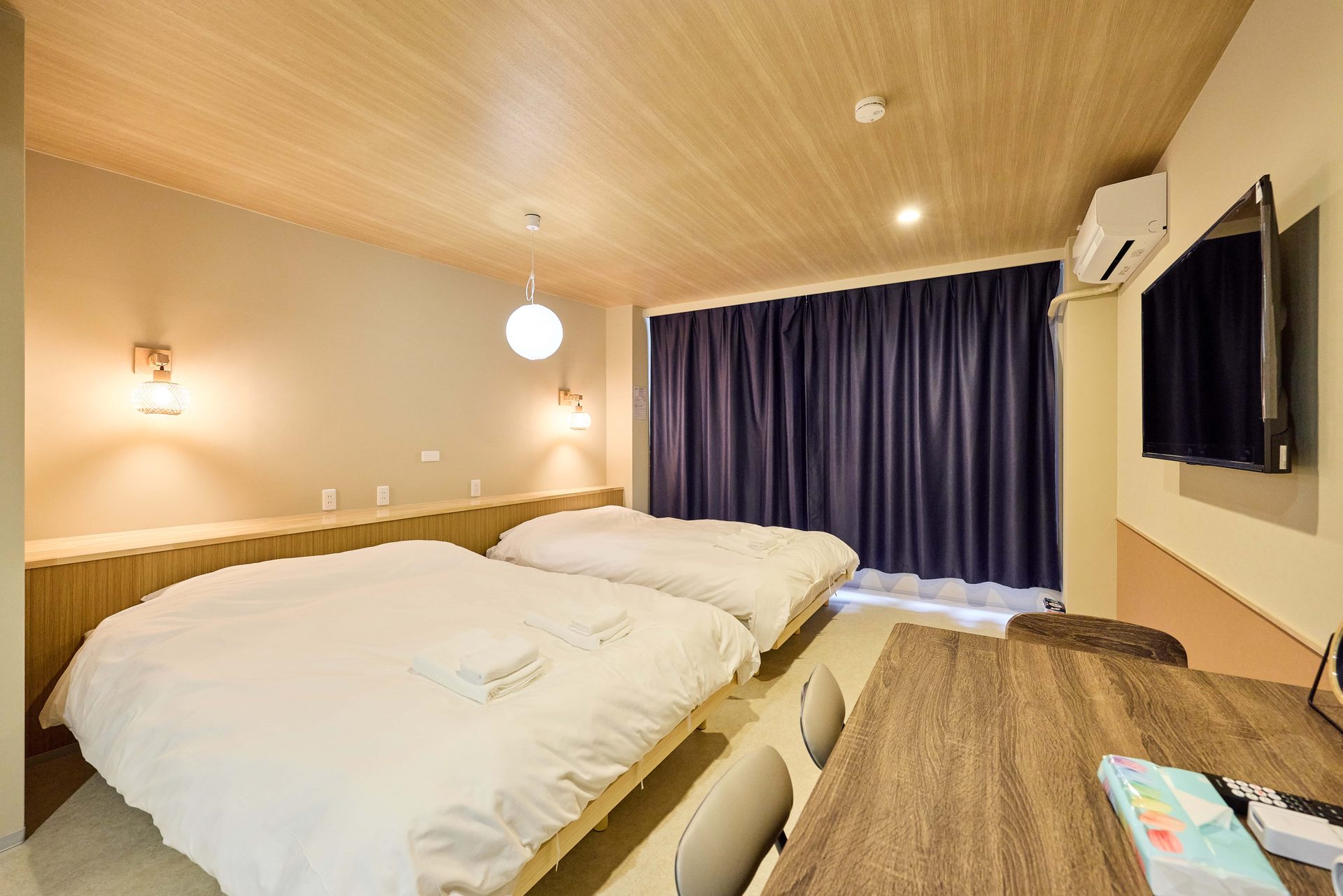
Why do the first and last day of an Osaka trip always end up stuck on luggage?
Because on both of those days you have luggage but no room. The real problem isn't that your luggage is heavy — it's that the timing doesn't line up.
Breaking it down makes it clearer:
- Arrival day. Getting from the airport into the city usually happens around midday, but check-in time is typically in the afternoon. That leaves a gap of several hours, and you're dragging all your luggage through it.
- Departure day. Checkout is usually in the morning, but your flight might not be until evening or later. You have half a day to sightsee, but your luggage is still with you.
- A day when you switch accommodation mid-trip. If you change where you're staying partway through, you go through both of the above all over again.
Most people's solution is "drop luggage at the accommodation first" — that's not wrong in itself, but it has a hidden cost: you take an extra detour just to put your bags down. If the accommodation happens to be on the way, fine; if it isn't, that round trip can eat one to two hours, right out of your most valuable first afternoon.
So the real question about luggage isn't "where can I put it," it's: "given today's route, which option costs the least detour?" The sections below answer exactly that.
It's also worth noting this is exactly why staying in one place for the whole trip saves so much hassle — luggage only gets moved in once and out once. With a group, that difference only gets bigger with more people. Accommodation planning for larger groups is covered separately in Osaka Group Stay Guide and Whole House or a Hotel?
How easy is it actually to find a coin locker at a station?
Big stations are easy to find but often full; small stations may not have any at all — and whether a station has one is something you can actually check ahead of time. No need to find out only once you're there.
The two operators' official lookup methods are the most reliable source, since it's the station's own information:
- JR West: on each station's information page on "JR Odekake Net," the "Other Services" section at the bottom states whether the station has coin lockers; stations with a station map also mark the locker location with an icon.
- Osaka Metro: each station's information page and station map list on-site facilities, coin lockers among them.
Taking Taisho Station, where we're located, as an example — we personally opened both operators' official pages to confirm:
- JR Taisho Station (Osaka Loop Line)'s official station page states "coin lockers: yes" under "Other Services."
- Osaka Metro Taisho Station (Nagahori Tsurumi-ryokuchi Line N11)'s official station page also lists coin lockers in its on-site facilities list.
⚠️ Honest limit: both official pages only state "yes" — they don't publish the number of lockers, sizes or pricing. So this page won't tell you how many lockers Taisho Station has, how big they are, or how much they cost — we don't have those figures, and writing them in would mean making them up. Go by the signage on site.
Also worth knowing: the number of coin lockers in Osaka has been increasing in recent years. In an official announcement dated July 22, 2024, Osaka Metro stated that, in preparation for Expo 2025 Osaka-Kansai, it had added a combined total of 227 lockers across 5 stations — Dobutsuen-mae Station (Midosuji Line), Tsuruhashi Station (Sennichimae Line), Ebisucho Station (Sakaisuji Line), and Namba Station (both the Yotsubashi Line and Midosuji Line) — and said it would continue expanding going forward.
Sources:
① JR West "JR Odekake Net" Taisho Station information https://eki.jr-odekake.net/top?id=0620505 (accessed 2026-08-24)
② Osaka Metro Taisho Station (N11) station information https://subway.osakametro.co.jp/station_guide/N/n11/ (accessed 2026-08-24)
③ Osaka Metro, "Coin Lockers Added Inside Stations!" July 22, 2024 https://subway.osakametro.co.jp/news/news/subway/20240722_locker_additional.php (accessed 2026-08-24)
A few practical tips for anyone using a coin locker for the first time:
- Earlier is always better. Big stations in tourist areas fill up fastest around midday — this happens every day, regardless of season.
- Take a photo of your locker number and location. Big stations often have more than one locker bank, and you'll thank yourself later when trying to find it again.
- Check the payment method first. Most newer units accept IC cards now, but coin-only machines still exist — keep some ¥100 coins on hand just in case.
- Confirm the storage time limit. Rules vary by operator, and overnight storage is usually billed differently — check the on-site signage for this.
What if my suitcase is too big to fit in a coin locker?
First confirm exactly how big your suitcase actually is, before deciding whether to keep hunting for a locker. A lot of people spend thirty minutes circling a station only to realize their suitcase was simply over the standard locker size to begin with.
There's an official set of numbers you can use as a benchmark — technically it governs "what you can bring on board," but it also happens to be a useful gauge of "how big your suitcase counts as, in Japan":
| JR West's rule | Details |
|---|---|
| Free carry-on baggage | Total of all three dimensions within 250cm (no single dimension over 2m), weight within 30kg, 2 pieces per passenger. Umbrellas, canes, handbags and similar personal items don't count toward the piece limit. |
| Shinkansen "oversized baggage" | Anything with the three dimensions totaling more than 160cm, up to 250cm counts as oversized baggage, and requires advance reservation for the oversized baggage storage area. |
| Not permitted on board | Hazardous items, bladed items, heaters and stoves, animals, unclean or foul-smelling items, and anything that could endanger other passengers or damage the train. |
Source: JR West "JR Odekake Net," "On Bringing 'Oversized Baggage' Onto the Shinkansen" https://www.jr-odekake.net/railroad/service/baggage/ (accessed 2026-08-24). ⚠️ Rules may change — check the official page before you travel.
How do you use these numbers? Simple: add up your suitcase's length + width + height. If that number is already close to or over 160cm, it counts as large baggage under Japan's rail system, and it being too big for a standard station locker is normal — not bad luck. In that case, jumping straight to a forwarding or counter service in the next section is usually more efficient than continuing to hunt for a locker.
One more thing that often gets overlooked: a group with several large suitcases. Even if each one individually fits, finding several consecutive empty lockers in the same spot is much harder. With more people, the difficulty of finding storage doesn't just add up — it compounds.
Besides coin lockers, what other storage and forwarding options are there?
Japan has a system driven by the Ministry of Land, Infrastructure, Transport and Tourism specifically built to solve this, called "tebura kanko" (hands-free tourism). Knowing this term changes how efficiently you can find services in Japan.
Per the ministry's official description, this system was set up to let visitors to Japan "use Japan's courier and forwarding services to sightsee hands-free." In practice, participating counters at airports, stations and commercial facilities display a common logo, so visitors can recognize which counters offer the service at a glance. The ministry also publishes the list of certified counters as open data, in both CSV and PDF formats, with an English-language list also available.
Sources:
① Ministry of Land, Infrastructure, Transport and Tourism, "Logistics: Promoting Hands-Free Tourism" https://www.mlit.go.jp/seisakutokatsu/freight/seisakutokatsu_freight_tk1_000069.html (accessed 2026-08-24)
② Ministry of Land, Infrastructure, Transport and Tourism, "Logistics: Open Data (Hands-Free Tourism Counter Information)" https://www.mlit.go.jp/seisakutokatsu/freight/seisakutokatsu_freight_tk1_000141.html (accessed 2026-08-24; the page's last-updated date is shown as Reiwa 8, August 20 — the CSV version includes discontinued counters, the PDF version does not)
Per the same official description, to qualify as a hands-free tourism counter, an operator must provide at least one of the following services: temporarily holding luggage at an airport, station or commercial facility, or forwarding luggage to your next destination (an airport, station, hotel, or an address overseas). In other words, the logo covers both "storage" and "forwarding" needs.
Another route is an airport luggage-forwarding service from a courier operator. Taking Yamato Transport's "Kuko Takkyubin" (Airport Courier) as an example, their official page states it can ship luggage between Narita, Haneda and Kansai International Airport (domestic flights) — outbound, from your accommodation to your departure airport; inbound, from the airport back to your accommodation or hotel. The official page also states that baggage over a certain weight isn't accepted, that shipping to the airport carries an additional handling fee, and that there's a discount rule when both the outbound and return legs are shipped through the service.
Source: Yamato Transport, "Airport Courier (Kuko Takkyubin)" https://www.kuronekoyamato.co.jp/ytc/customer/send/services/airport/ (accessed 2026-08-24). ⚠️ Fees and eligibility are set by the operator and subject to change — check the official page before shipping; we operate independently from this operator, and this is simply an official source you can verify for yourself.
Putting all three approaches side by side makes it easier to choose:
| Approach | Best suited for | What to watch for |
|---|---|---|
| Station coin locker | Only need storage for a few hours, luggage isn't large, and you'll return to the same station that day. | May be full, may not fit, and larger stations may have more than one locker bank. |
| Hands-free tourism counter | Large or multiple pieces of luggage, or you want it sent straight to your next destination. | Counter locations and hours vary by operator — check the official open data or on-site signage. |
| Airport luggage forwarding | Your last day before flying home, or you don't want to drag a large suitcase around on a travel day. | Has a weight limit and a cutoff time, and needs lead time to ship — it doesn't arrive the same day. |
How do I plan check-in and checkout times around my itinerary?
Shinsai Wings' check-in is 16:00 and checkout is 10:00, with a minimum stay of 2 nights. Put those two numbers into your itinerary first, and a lot of the confusion just doesn't happen.
We're stating our own time constraints upfront because this is exactly part of what this article is meant to solve. Sidestepping it and only talking about how many lockers are outside wouldn't actually help you.
In practice, a smoother way to plan it looks like this:
- Arrival day: deal with your luggage first, then start sightseeing. Whether that's storing it, forwarding it, or sending it ahead near your accommodation, the point is "don't drag your luggage through your itinerary." Plan your afternoon somewhere you won't need to change or go back to the room.
- Departure day: plan your last half-day somewhere that doesn't require dragging luggage. After checkout, if your flight is in the afternoon or evening, ship or store your luggage first, then go do one last round.
- Every day in between: nothing to worry about at all. This is the biggest advantage of staying in one place — your luggage just stays in the room every day in between.
One more piece of Osaka-specific regulatory background: the City of Osaka requires special-zone minpaku properties to have "the period the facility is made available for use be 3 days (2 nights) or more," meaning a minimum stay of 2 nights, and the city's own page states plainly that a single-night stay isn't possible. So when you see "minimum 2 nights" while searching for minpaku in Osaka, it's usually not the operator being picky — it's the regulation.
Source: City of Osaka, "On the Minimum Number of Nights for Special-Zone Minpaku" https://www.city.osaka.lg.jp/keizaisenryaku/page/0000671598.html (accessed 2026-08-24)
⚠️ Honest limit: whether early check-in or late checkout is possible isn't part of what we've already confirmed, so this page won't give you an answer that sounds considerate but has no basis. To ask about either of those, please ask the host directly.
What should I know about bringing large luggage to a whole-house minpaku stay?
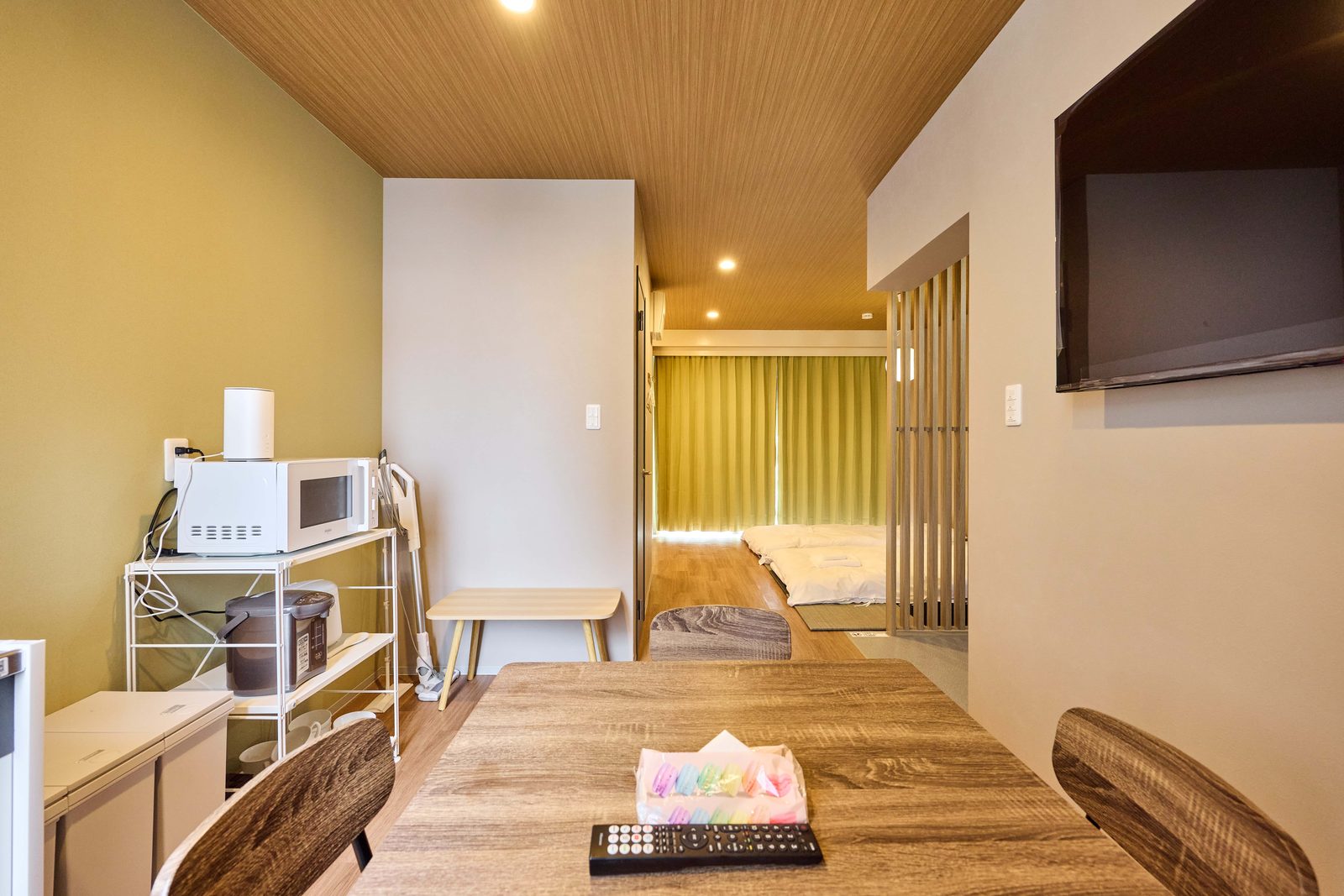
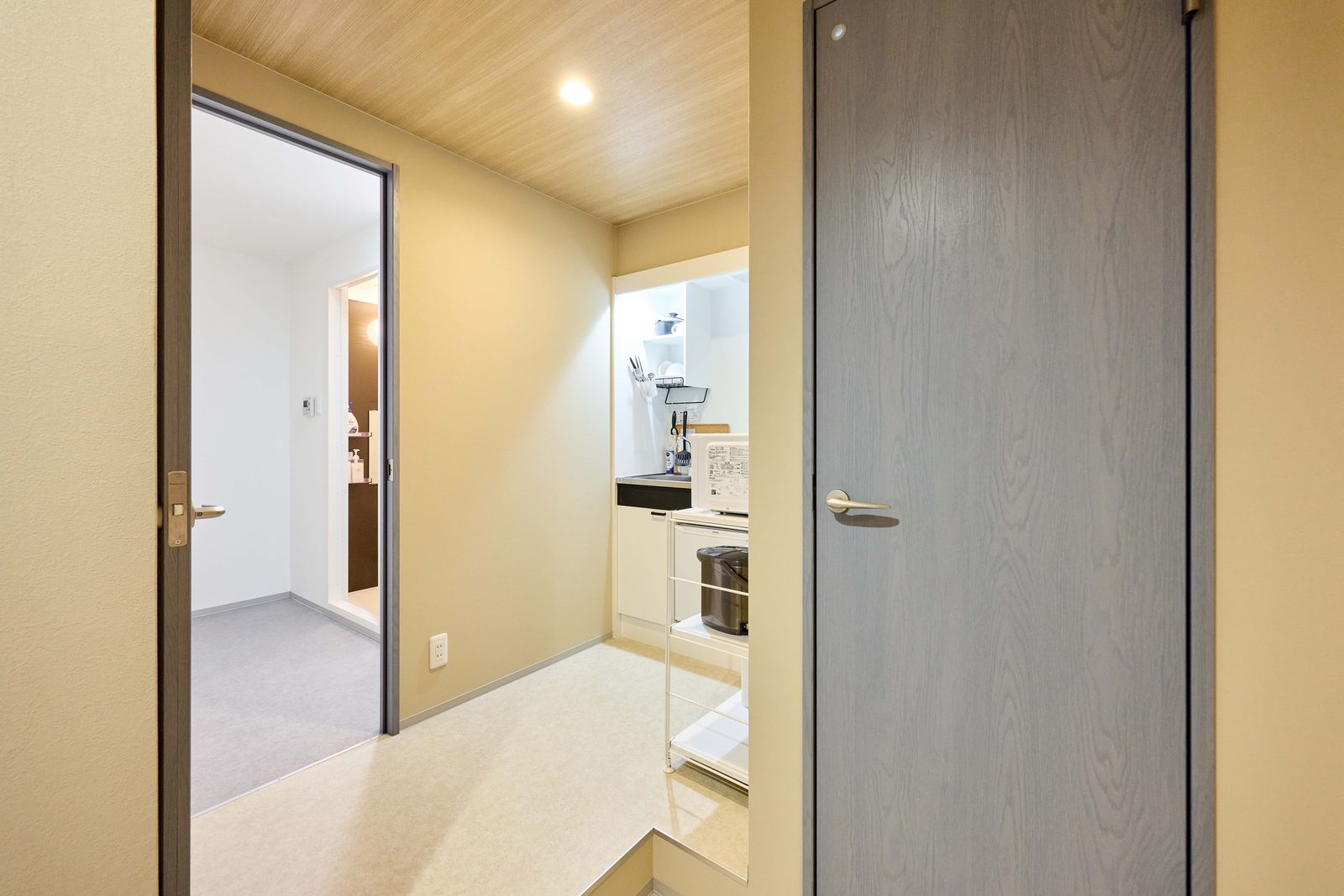
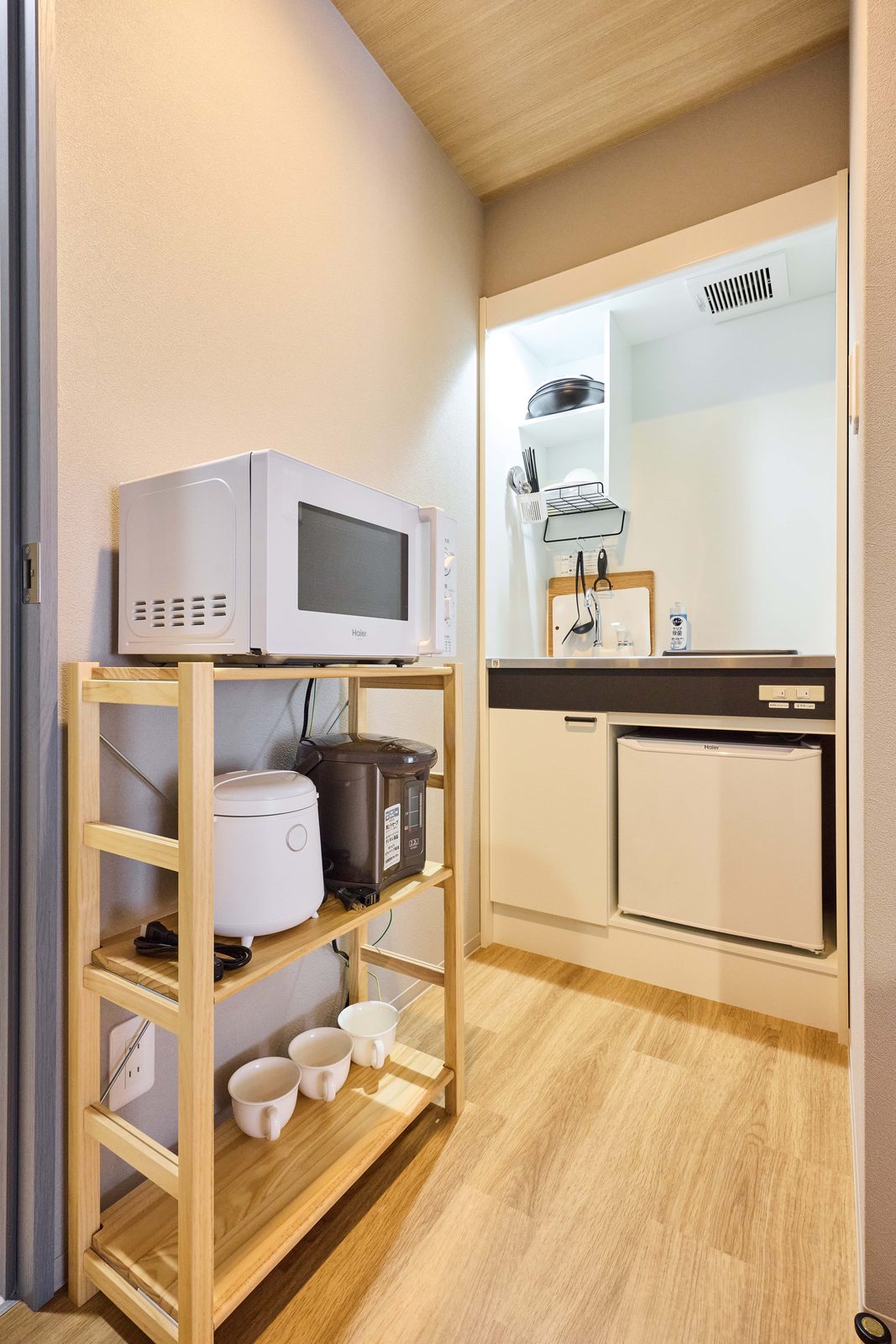
The most useful thing you can do is arrange your luggage route before you even book. Tell us who's traveling with you and how many bags when you book, and we'll help arrange the room type with the easiest layout for getting in and out — Room A, for example, has zero-hassle luggage access.
The reason we can do this is simple: because every room type is a fully independent whole unit, room type itself is something we can discuss. This is something we can actually do, not just a talking point.
A few general tips for bringing large luggage to a whole-house minpaku stay:
- Weight matters more than size. Moving it around for the whole trip, a 30kg case and a 15kg case are completely different experiences. Leave room on the outbound leg rather than loading all the weight on the way there.
- Move everything in one trip, not back and forth. Gather all the luggage at the entrance first, then distribute it, rather than everyone carrying their own separately.
- Consider shipping souvenirs home directly. Rather than cramming your suitcase to its limit and hauling it the whole way, use the airport forwarding option mentioned above instead.
- Wipe down your suitcase wheels. It's a courtesy, and it also protects the indoor flooring — especially in room types with tatami. Room-type arrangements for tatami are covered in a dedicated article, see Osaka Tatami Room Stays.
🔴 The single most important sentence in this section: this page covers the methods and sources for Osaka's various luggage storage and forwarding options in general; luggage storage at this specific property is listed on this site as unconfirmed, and follows whatever you and the host confirm directly. The only reliable answer for our own property's luggage service is whatever the host tells you at the time.
How should I plan my luggage route on arrival day and departure day?
Just remember one principle: let your luggage move separately from you, not together with you. Itineraries fall apart almost entirely because a person and their luggage are tied together.
Broken down into a sequence you can actually follow:
- Before you leave (still at home). Measure your suitcase's three dimensions added together, so you have a number in mind. While you're at it, decide whether to ship souvenirs home on the return leg.
- Arrival day, before entering the city. Decide which route your luggage takes: staying with you, storage, or forwarding. The earlier this decision is made, the easier everything after it becomes.
- Arrival day afternoon. Plan your itinerary somewhere that doesn't require going back to your accommodation. If you do need to go back to drop off luggage, put that trip in your itinerary rather than pretending it isn't happening.
- The night before you leave. Split your luggage into "what I need tomorrow morning" and "everything else." Doing this step saves half an hour of scrambling the next morning.
- Departure day. Deal with your luggage right after checkout, then do your last leg of sightseeing. When timing this, factor in both rush-hour transit and your flight's check-in deadline.
If you're arriving or leaving via Kansai International Airport, the transit for that leg is fully covered in Kansai Airport to Taisho Station — that article covers "how to get there," this one covers "what to do with your luggage once you have," and the two work best read together.
What should I ask the host about luggage before booking?
Three questions cover it: your rough arrival and departure times, headcount and number of bags, and what room type would be recommended. No need to be overly formal about it — asking directly is fastest.
Messages you can send as-is:
- "We're arriving in Osaka around midday on November 3rd, 4 adults with 3 large suitcases — any suggestions for the arrival-day route?"
- "Our flight home is in the evening on departure day, and we'd like to deal with our luggage right after checkout — any suggested approach?"
- "There's an older family member with us and we have quite a bit of luggage — how could the room type be arranged?"
Shinsai Wings is run directly by Taiwanese hosts, and the official LINE communicates directly in Chinese, with no translation layer and no waiting on a platform's messaging system. That's the one thing we can clearly guarantee — ask in Chinese, and someone will reply in Chinese.
What official sources does this article cite?
All of them are listed here, and every one was written into this article only after we actually opened the page and confirmed its contents on 2026-08-24. If you find any of them out of date, go by the official page.
- Ministry of Land, Infrastructure, Transport and Tourism, "Logistics: Promoting Hands-Free Tourism" — system definition and common logo: mlit.go.jp
- Ministry of Land, Infrastructure, Transport and Tourism, "Logistics: Open Data (Hands-Free Tourism Counter Information)" — certified counter open data: mlit.go.jp
- JR West "JR Odekake Net," "On Bringing 'Oversized Baggage' Onto the Shinkansen" — size and weight rules: jr-odekake.net
- JR West "JR Odekake Net" Taisho Station information — coin locker availability: eki.jr-odekake.net
- Osaka Metro Taisho Station (N11) station information: subway.osakametro.co.jp
- Osaka Metro, "Coin Lockers Added Inside Stations!" (2024-07-22) — 227 lockers across 5 stations: subway.osakametro.co.jp
- Yamato Transport, "Airport Courier (Kuko Takkyubin)" — eligible airports, weight limits and fee rules: kuronekoyamato.co.jp
- City of Osaka, "On the Minimum Number of Nights for Special-Zone Minpaku" — 2 nights (3 days) or more: city.osaka.lg.jp
📌 Every source cited in this article is an official primary source. ⚠️ Kansai International Airport's official baggage-service page could not be loaded on the day we checked, so this article's source list is limited to the other official pages that were readable — better to list one fewer source than to include one without a citation.
Shinsai Wings — Verified Facts
- Check-in 16:00 / check-out 10:00; minimum stay 2 nights; no pets
- Every room type is a fully independent whole unit, and room assignment can be discussed based on your needs (tell us your luggage situation when booking, and we'll help arrange the room type with the easiest layout for getting in and out)
- Location: Sangenya-higashi, Taisho Ward, Osaka, a standalone building, a rare steel-frame structure, newly renovated
- Whole house up to 16 guests (Room A, B, C and D; Room D is a loft)
- Every room type has its own private bathroom, and all include a bathtub; private kitchen and private dining area; large balcony comes with Room B, C and D
- Has a washing machine and dryer, available to nightly guests too (our service scope is the equipment being available to use; washing is done by the guest)
- Tatami bedroom comes with Room A and Room D only
- Taisho Station is served by both the JR Osaka Loop Line and the Osaka Metro Nagahori Tsurumi-ryokuchi Line
- Shinsaibashi: direct from Taisho Station, 4 stops, about 6 minutes, ¥190 (Taisho is the terminus, board at the starting station)
- Universal Studios Japan: 1 transfer at Nishikujo, about 18-22 minutes, ¥200
- Room B, C and D are certified under Osaka's special-zone minpaku rule and can operate year-round under a licensed management company; Room A is a regular minpaku (annual cap of 180 nights)
- 📌 Luggage storage at this property is listed on this site as unconfirmed, and follows whatever the host tells you at the time — ask the official LINE directly before you book
Want to sort out your luggage plan for arrival or departure day before your trip? Tap "Free help booking your Osaka stay" at the bottom right to ask the host directly, official LINE: @040fyjwd, run directly by Taiwanese hosts, communicating in Chinese with no barrier.
Is your group staying together for a few nights, or is it just you staying a month or more?
Same building, same hardware, two ways to stay: a group renting the whole house (up to 16 people), or one person on a monthly long stay (from one month). Click through for the facts table, room-assignment logic, and how to ask about availability.
Still deciding? Add us on Official LINE @040fyjwd and tell us your move-in month and length of stay.