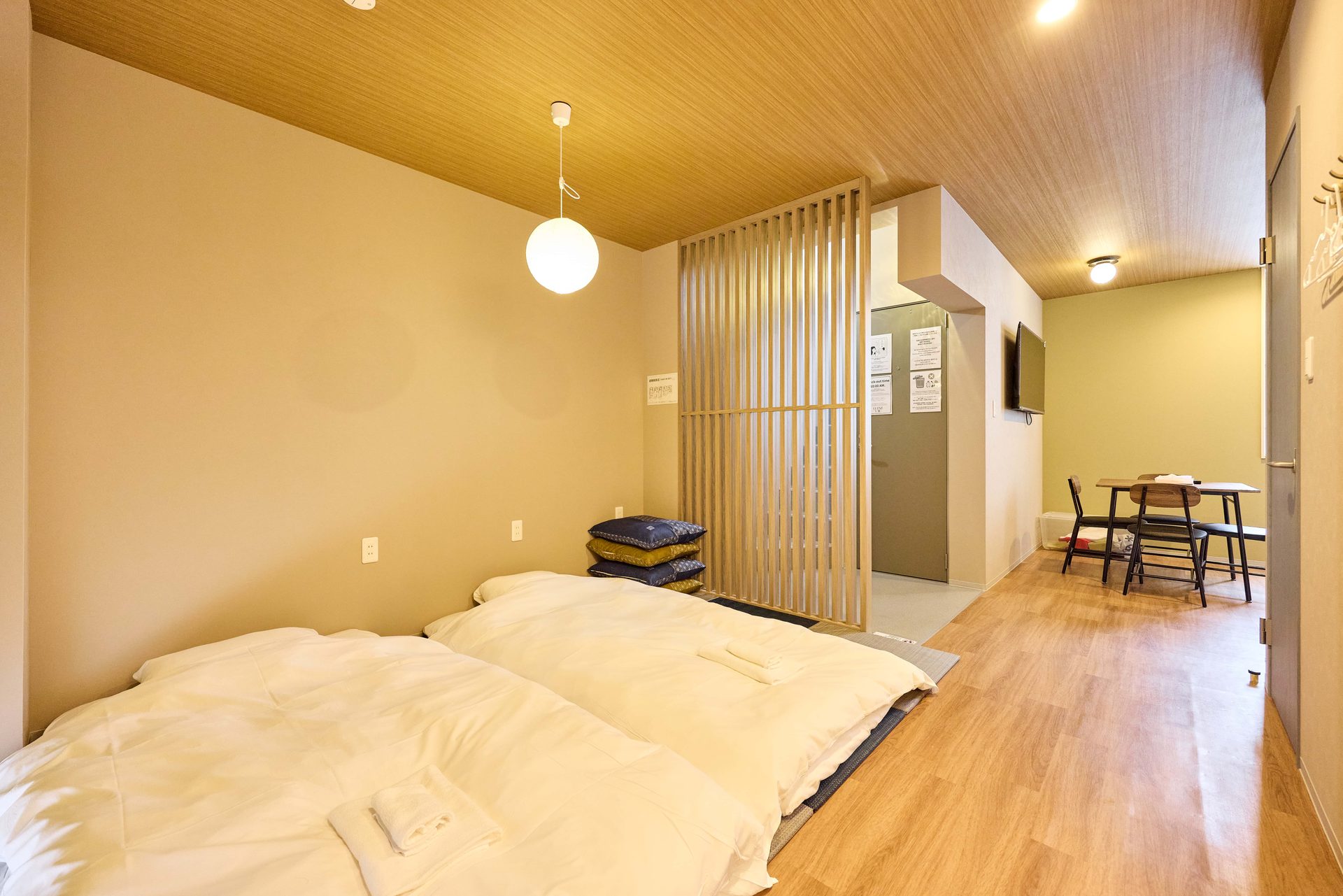
Want to sleep on tatami in Osaka — what should I confirm before booking?
Confirm which room type the tatami is in first, rather than checking whether the property lists a "Japanese-style room." This is the single most important sentence in this article — if you only read one part, read this one.
The reason is simple: at accommodation in Osaka — hotel, ryokan or minpaku alike — within the same building, tatami is usually only fitted in some of the room types. The description text on a booking page is written for the whole property; the room-type page is written for the specific room you'll actually get. Most people don't get caught out by false information, they get caught out by treating the whole-property description as a guarantee for their own room.
What makes it worse: Chinese-language booking platforms often translate the Japanese terms washitsu (Japanese-style room), wayoshitsu (Japanese-Western room) and tatami supesu (tatami space) all into the same word, so they all look like they have tatami — but in practice they're very different:
| What you might see | What it usually actually means |
|---|---|
| Japanese-style room (washitsu) | The entire room is floored in tatami, and you sleep on bedding laid directly on the tatami. This is what most people picture as "sleeping on tatami." |
| Japanese-Western room (wayoshitsu) | The room has both a bed and a tatami area. There's tatami, but you may not actually be sleeping on it. |
| Tatami area / raised platform (koagari) | A small section of the room is floored in tatami, functioning more like a raised seating area than somewhere to sleep. |
| Western-style room (yoshitsu) | The entire room has a Western-style floor. Sometimes a whole-property description uses the word "Japanese-inspired," which refers only to the décor style. |
※ The table above summarizes labeling conventions commonly used across different properties — it isn't a spec claim by any specific operator. For the actual content of a room type, go by the official description of the specific one you're booking.
So the most effective question to ask before booking ties the question to the specific room you're getting: "Does the room type I'm booking have tatami?" Ask whether the whole property has it, and the answer is almost always "yes." Ask about your own specific room, and that's the answer you actually need.
Why do so many people feel they have to sleep on tatami at least once in Japan?
Because it's one of the few accommodation experiences where you know you're in Japan the moment you walk in. Sight, touch, even scent — three things happen at once, and none of them come from a hotel bedsheet.
The woven surface of tatami is called tatami-omote, made from igusa (rush grass). According to Japan's Ministry of Agriculture, Forestry and Fisheries (MAFF), almost all of the igusa grown domestically in Japan now comes from Kumamoto Prefecture; the same official source also records that "Kumamoto-grown igusa" and "Kumamoto-grown igusa tatami facing" were registered under the Geographical Indication (GI) protection system in February of Heisei 28 (2016). In other words, that grassy scent you notice isn't a decorating material's scent — behind it is an agricultural product with a recognized place of origin.
Source: Ministry of Agriculture, Forestry and Fisheries, "Igusa & Tatami-Omote" https://www.maff.go.jp/j/seisan/tokusan/igusa_tatami-omote.html (accessed 2026-08-24). We haven't cited any "percentage domestic" figure, because the page itself doesn't state one — writing one in would mean making it up.
Beyond the scent, there are two more differences that are hard to describe in words but obvious once you've experienced them:
- The feel underfoot is different. Wood flooring is hard, carpet is muffled, tatami sits somewhere in between — the feedback of walking barefoot on it is distinctive.
- The whole room feels a different height. With bedding laid directly on the floor, your eye level drops, and the room looks more spacious than it measures. This is one real reason people describe a Japanese-style room as "more relaxing."
If this trip is with family, and it's your first time in Japan, a night on tatami is often the detail people bring up most once they're home. It's not essential, but it's the kind of thing that feels like a small missed opportunity if you skip it.
What's actually different about staying in a tatami room versus a regular bed room?
The biggest difference is that "the floor is usable space." In a bed room, the usable space is whatever's left around the bed; in a tatami room, the usable space is the entire floor.
That sounds abstract, but the difference is very concrete when a group is traveling together:
- Luggage can be spread out. A bed room usually has just one luggage rack, so two or more people end up taking turns opening their suitcases. A tatami room lets several be open at once.
- Everyone can sit in a circle. Sorting through the day's purchases back at the room, planning tomorrow, eating a late-night convenience-store snack — a bed room means squeezing around the edge of the bed; a tatami room means just sitting down.
- Kids have somewhere to be. Covered on its own in the next section.
- Daytime space "resets." Once the bedding is put away, the whole floor is usable again, and the room feels like it's grown.
There are trade-offs too, worth covering here so you're not caught off guard:
- Getting up works differently. Standing up from the floor is a different motion than standing up from the edge of a bed, and it's noticeable for anyone with knee or back issues.
- Watch your suitcase wheels. Tatami doesn't hold up well against sharp, hard objects being dragged across it, so most properties ask that suitcases stay off the tatami area. That's not the property being difficult — it's protecting the material.
- Where you take your shoes off matters more. A Japanese-style room usually has a clear line where shoes come off, which is easy to forget when you're rushing in with kids in tow.
Overall, a tatami room suits a trip where you'll actually spend time in the room, while a bed room suits a trip where you're just coming back to sleep. It's not a question of better or worse — it's a question of how you're spending this trip.
Traveling with a young child — is tatami actually better?
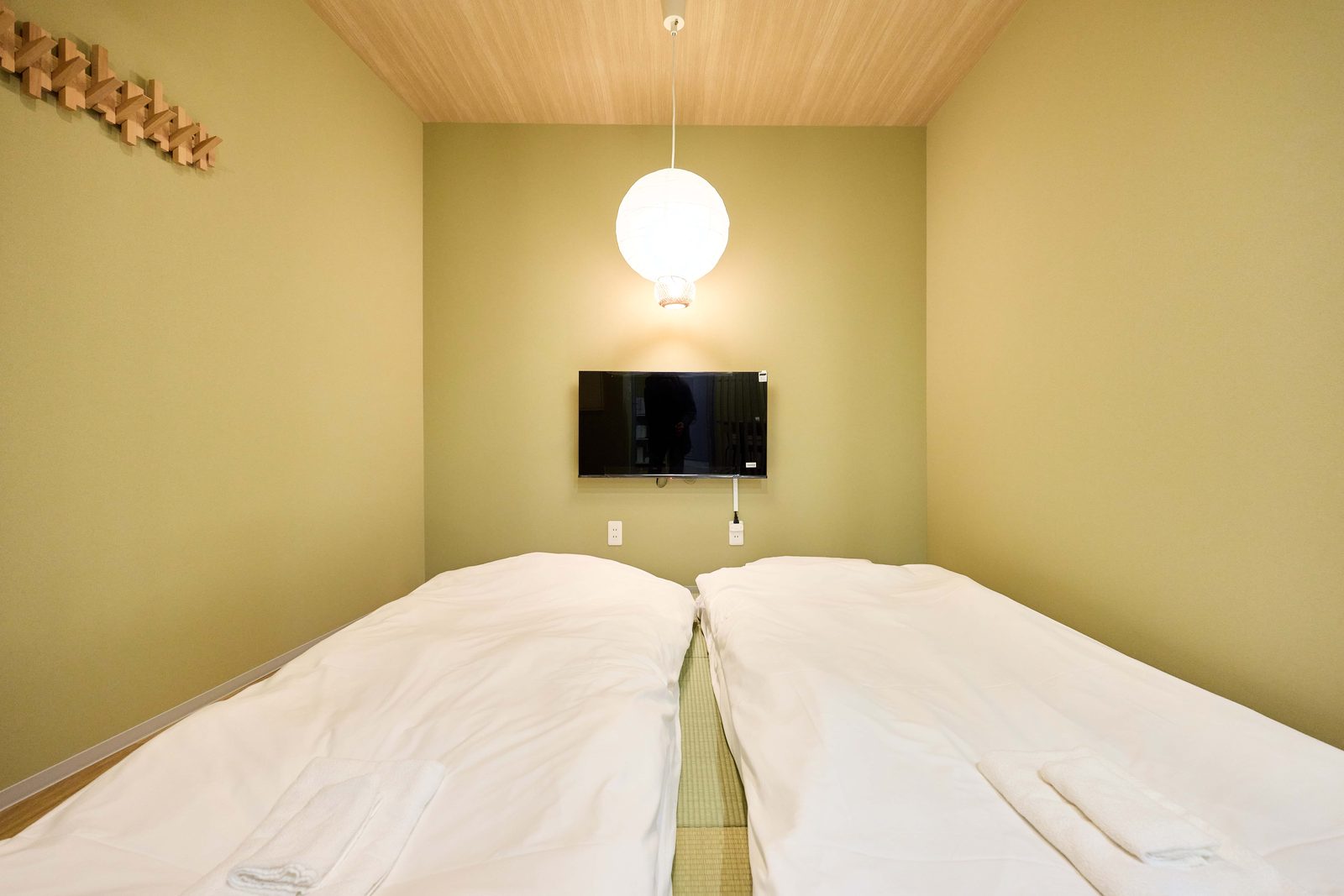
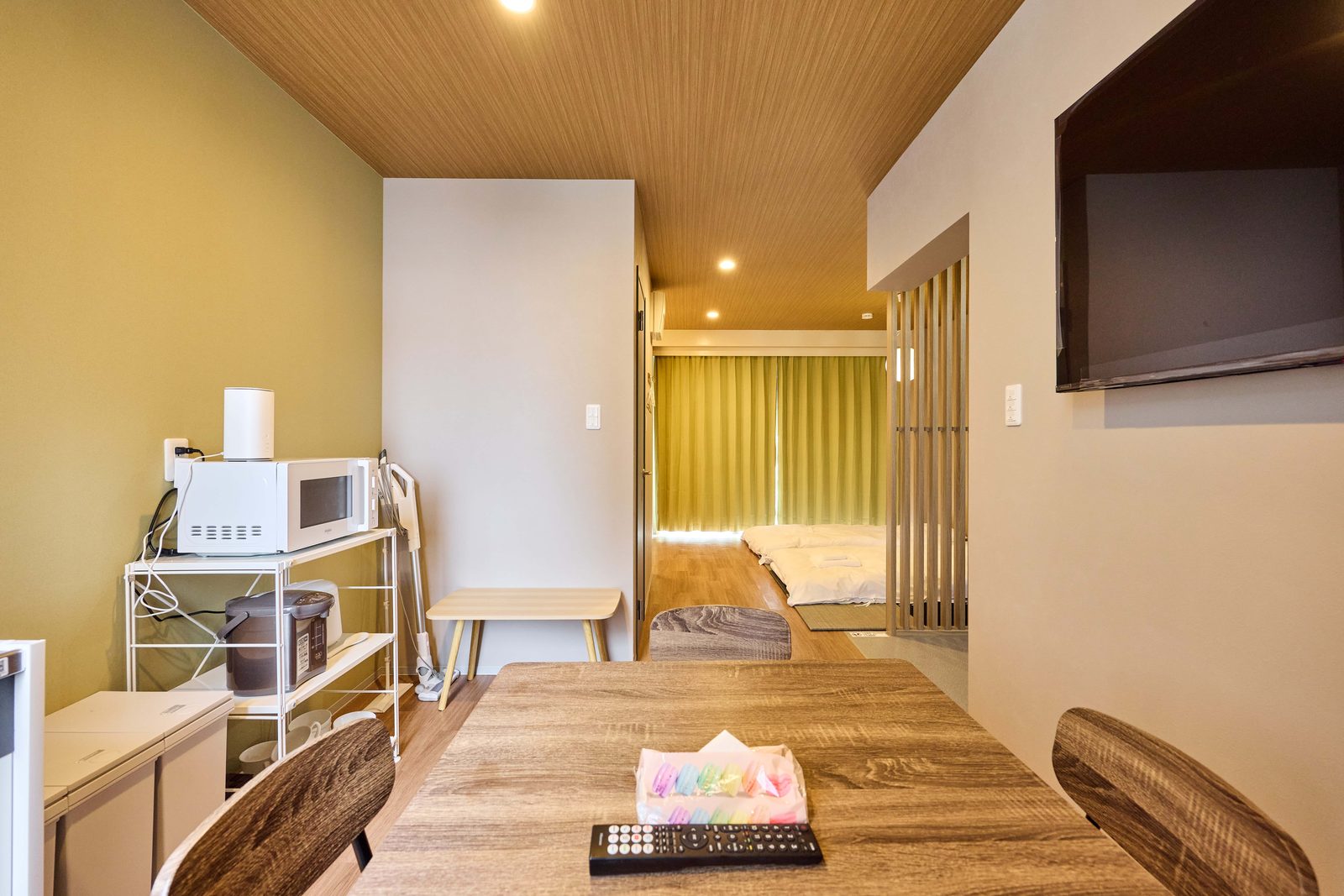
In most cases, yes, mainly because there's no risk of falling off a bed. Almost anyone who's stayed at a hotel with a young child has been through the same thing: getting up repeatedly through the night to check the child hasn't rolled to the edge.
With bedding laid directly on tatami, that anxiety mostly disappears. A few other practical upsides come with it:
- You can sleep together. No need to book an extra room over "is the bed wide enough," and no need to force two twin beds together with a gap between them.
- Kids have a safe range to move in. A crawling or newly-walking child is much safer moving around on tatami than in a room full of bed legs, nightstands and luggage racks.
- Diaper changes and feeding don't need bending over. Handling it right there on the floor is much easier on your back over time.
- Toys spread out on the floor don't block the way. A bed room's floor space is often only wide enough to squeeze past sideways.
But it's not all upside:
- Watch ventilation in summer. Sleeping closer to the ground means the temperature you feel is different from up on a bed, so the air conditioning direction may need adjusting.
- Tatami doesn't help if you need a guardrail. If your child is used to a crib with rails, that's a different need — check directly with the property.
- Assess older family members separately. What suits a child doesn't necessarily suit a grandparent. When three generations travel together, the best approach is usually putting different family members in different room types, rather than cramming everyone into the same one.
For other things to prepare when traveling to Osaka with kids, see the dedicated Osaka Family Stay Guide; because laundry is especially relevant to family trips, it also has its own article: Does Osaka Accommodation Have a Washing Machine?
Does sleeping on tatami cause back pain? How do I sleep more comfortably?
Whether it causes back pain varies by person — there's no universal answer, and we're not going to pretend to give you one. In practice, the biggest factor is how soft the bed you normally sleep on is — the bigger that gap, the more likely you'll need a night or two to adjust.
A few directions you can gauge for yourself:
- If you usually sleep on a firmer mattress, you'll typically adjust on the first night, and may even find it more comfortable than a soft hotel bed.
- If you usually sleep on a very soft memory-foam mattress, the first night may feel like there's no support under your lower back — by the second night, it's usually fine.
- If you have a diagnosed lower-back condition, please consult your own medical provider before deciding. In that case, whether to sleep on tatami is a health question, not a travel one — go by your own medical advice.
Two more practical tips that need no extra equipment and can be tried the same night: side sleepers can ask for an extra pillow to place between the knees; anyone who finds it too firm can fold a bath towel and place it under the lower back.
⚠️ Honest disclosure: the firmness of Shinsai Wings' tatami-room bedding is listed on this site as unconfirmed, so this section describes general principles, and our own actual bedding is whatever the host confirms. If it matters to you, ask the host directly about the bedding style for that room type — that's far more useful than us writing a description that merely sounds plausible.
What's the difference between a hotel's Japanese-style room, a ryokan's, and a minpaku's tatami room?
The difference isn't just décor — it's also the operator's regulatory status, and that directly affects whether you can book just a single night. This is where a lot of people researching Osaka tatami stays get stuck without knowing why.
In Osaka, properties that all look like "minpaku" on the surface may actually operate under two completely different systems:
| System | What it actually means for your booking |
|---|---|
| Special-zone minpaku (National Strategic Special Zone Foreign Visitor Lodging Business) |
Osaka City's rule requires "the period the facility is made available for use to be 3 days (2 nights) or more," meaning a minimum stay of 2 nights, and the city's own page states plainly that a single-night stay isn't possible. If you only want one night, this type of property won't be open to you. |
| Private Lodging Business (minpaku shinpo) | Per the Ministry of Land, Infrastructure, Transport and Tourism, "the annual cap on days provided is 180 days," and the year is defined as running "from noon on April 1 each year to noon on April 1 the following year," not the calendar year. This means the property won't be open every single day, so gaps in the availability calendar you see are expected. |
| Ryokan / hotel | Operates under the hotel business system, and usually allows a single-night stay, but the number of tatami room types tends to be small and is often concentrated in specific room codes. |
Sources:
① City of Osaka, "On the Minimum Number of Nights for Special-Zone Minpaku" https://www.city.osaka.lg.jp/keizaisenryaku/page/0000671598.html (accessed 2026-08-24)
② City of Osaka, "Osaka City National Strategic Special Zone Foreign Visitor Lodging Business (Special-Zone Minpaku)" https://www.city.osaka.lg.jp/kenko/page/0000341012.html (accessed 2026-08-24)
③ Ministry of Land, Infrastructure, Transport and Tourism / Japan Tourism Agency, Minpaku System Portal Site, "What Is the Private Lodging Business Act (Minpaku Shinpo)?" https://www.mlit.go.jp/kankocho/minpaku/overview/minpaku/law1.html (accessed 2026-08-24)
Once you know this, there are two search habits worth changing right away:
- Seeing "minimum 2 nights" isn't the operator being picky. In Osaka, that's very likely a regulatory requirement, not an attitude problem.
- Don't over-interpret gaps in an availability calendar either. Properties under different systems have different opening logic by design — that's a separate question from how popular the place is.
Which room types have tatami at Shinsai Wings?
A tatami bedroom comes with Room A and Room D only.
This has to be stated by room type, because it directly affects your booking outcome: if you want to sleep on tatami and end up booking Room B or Room C, there won't be one. We'd rather say this clearly in the article than have you find out only after arriving.
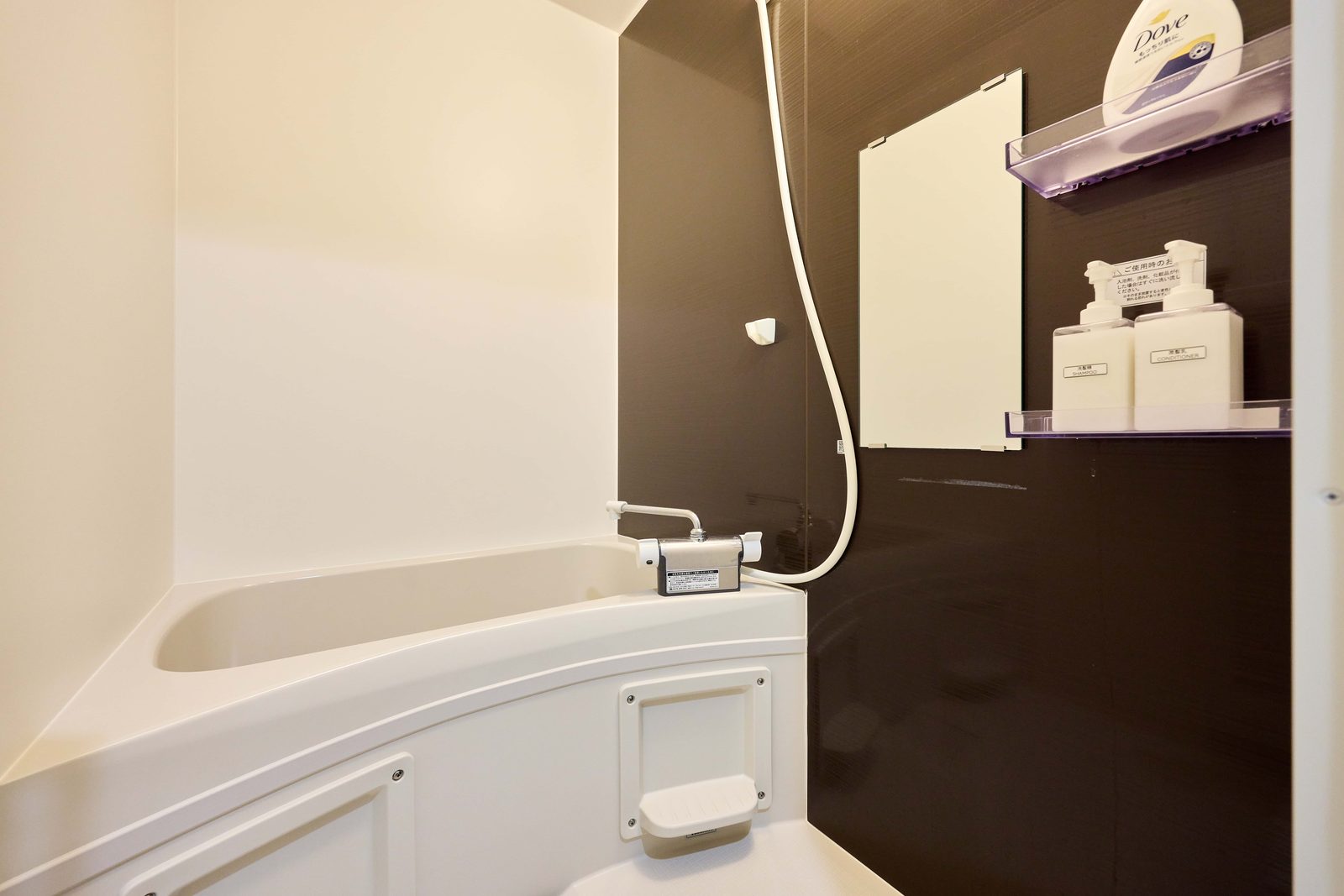
Shinsai Wings is a standalone building in Sangenya-higashi, Taisho Ward, Osaka, a rare steel-frame structure, newly renovated. Every room type is a fully independent whole unit, the only one of its kind in the house, each with its own private bathroom (including a bathtub) and private kitchen and dining area; a large balcony comes with Room B, C and D. The whole house holds up to 16 guests.
A few more things worth stating honestly:
- Room type can be arranged to fit your needs. Tell the host who's traveling with you and your luggage situation before booking, and we'll help arrange the room type with the easiest layout for getting in and out — Room A has zero-hassle luggage access.
- The washing machine and dryer are "equipment provided, guest operates." Nightly guests can use them too. Our service scope ends at "the equipment is available to use," and washing and drying is done by the guest.
- No pets; check-in 16:00 / check-out 10:00; minimum stay 2 nights.
⚠️ To be clear about the scope of this section:
Room size — go by the actual video and photos on this page.
Headcount — the only headcount figure we've verified is "whole house up to 16 guests"; for a specific room type, tell the host who's traveling and let them arrange it based on the actual situation.
Transit — this site provides the nearest station, route, travel time and fare; for the walking route from the station to the door, go by a map app's live result.
Rates and availability — the nightly rate follows whatever's shown on that room type's Airbnb listing page at the time; availability follows the official LINE's reply at the time.
All of these you can get an answer to just by asking the host — better than us guessing here.
Staying in a tatami room in Taisho Ward — is it convenient for Shinsaibashi and Universal Studios Japan?
Shinsaibashi is direct; Universal Studios Japan needs one transfer. Both are within reasonable range, but the wording has to be precise, because these two get misstated often.
- Shinsaibashi: from Taisho Station on the Osaka Metro Nagahori Tsurumi-ryokuchi Line, 4 stops, about 6 minutes, ¥190. It's direct because Taisho is the terminus of this line — you board at the starting station, no transfer needed.
- Universal Studios Japan: take the JR Osaka Loop Line to Nishikujo Station, transfer to the JR Yumesaki Line (Sakurajima Line), 1 transfer, about 18-22 minutes total (varies slightly by train), ¥200. The full route is a single change at Nishikujo; the time is given as a range because it varies with the specific train.
Taisho Station itself is served by both the JR Osaka Loop Line and the Osaka Metro Nagahori Tsurumi-ryokuchi Line — that's its real value as a place to stay: toward the city center and toward Universal Studios Japan are two different directions, so you don't have to give up one for the other.
Sources:
① Osaka Metro, "Fares & Passes (Subway / Osaka City Bus)" — subway standard fare "Zone 1 (up to 3km), adult ¥190" https://subway.osakametro.co.jp/guide/fare/fare/price.php (accessed 2026-08-24)
② Osaka Metro Taisho Station (Nagahori Tsurumi-ryokuchi Line N11) station information https://subway.osakametro.co.jp/station_guide/N/n11/ (accessed 2026-08-24)
③ JR West "JR Odekake Net" Taisho Station information https://eki.jr-odekake.net/top?id=0620505 (accessed 2026-08-24)
⚠️ Actual schedules and travel times for each line are subject to timetable changes — check the day's actual timetable before you travel. A more complete transit rundown for Taisho Station is in the internal link below.
The full transit rundown from Taisho Station to various sights is written up in Taisho Station Area Guide — not repeated here.
I want a tatami room type — how do I ask before booking?
Just state three things directly: your dates, headcount, and that you want a room type with tatami. That's it — no need for a formal opener.
Why ask instead of just booking directly? Because only some room types have tatami, and room assignment can't be reflected live on the website. Rather than guess yourself, one message covers it. A message you could actually send might look like this:
- "We're staying November 3-6, four adults and one child, and we'd like a room type with tatami — how can this be arranged?"
- "There's an older family member with us and we have quite a bit of luggage — could you suggest the most convenient room type for getting in and out?"
- "I'd like tatami, but I also want to confirm the laundry setup and kitchen location — can you cover both?"
Shinsai Wings is run directly by Taiwanese hosts, and the official LINE communicates in Chinese, with no translation layer and no waiting on a platform's messaging system. That's the one thing we can genuinely guarantee — ask in Chinese, and someone will reply in Chinese.
What official sources does this article cite?
All of them are listed here, and every one was written into this article only after we actually opened the page and confirmed its contents on 2026-08-24. If you find any of them out of date, go by the official page.
- Ministry of Agriculture, Forestry and Fisheries, "Igusa & Tatami-Omote" — igusa's place of origin and GI registration: maff.go.jp
- Ministry of Land, Infrastructure, Transport and Tourism / Japan Tourism Agency, Minpaku System Portal Site, "What Is the Private Lodging Business Act (Minpaku Shinpo)?" — the 180-day cap and how the year is counted: mlit.go.jp
- City of Osaka, "On the Minimum Number of Nights for Special-Zone Minpaku" — 2 nights (3 days) or more: city.osaka.lg.jp
- City of Osaka, "Osaka City National Strategic Special Zone Foreign Visitor Lodging Business (Special-Zone Minpaku)": city.osaka.lg.jp
- Osaka Metro, "Fares & Passes" — subway standard fare zone table: subway.osakametro.co.jp
- Osaka Metro Taisho Station (N11) station information: subway.osakametro.co.jp
- JR West "JR Odekake Net" Taisho Station information: eki.jr-odekake.net
📌 Every source cited in this article is either our own verified data or an official primary source, and every one is a page we personally opened and confirmed. Kansai International Airport's official baggage-service page could not be loaded on the day we checked, so this article's source list is limited to the other pages that were readable.
Shinsai Wings — Verified Facts
- A tatami bedroom comes with Room A and Room D only
- Location: Sangenya-higashi, Taisho Ward, Osaka, a standalone building, a rare steel-frame structure, newly renovated
- Whole house up to 16 guests; four fully independent room types (Room A, B, C and D; Room D is a loft)
- Every room type has its own private bathroom, and all include a bathtub
- Private kitchen and private dining area; large balcony comes with Room B, C and D
- Has a washing machine and dryer, available to nightly guests too (our service scope is the equipment being available to use; washing is done by the guest)
- Check-in 16:00 / check-out 10:00; minimum stay 2 nights; no pets
- Taisho Station is served by both the JR Osaka Loop Line and the Osaka Metro Nagahori Tsurumi-ryokuchi Line
- Shinsaibashi: direct from Taisho Station, 4 stops, about 6 minutes, ¥190 (Taisho is the terminus, board at the starting station)
- Universal Studios Japan: 1 transfer at Nishikujo, about 18-22 minutes, ¥200
- Room B, C and D are certified under Osaka's special-zone minpaku rule and can operate year-round under a licensed management company; Room A is a regular minpaku (annual cap of 180 nights)
Want to specify a room type with tatami, or check the room arrangement for everyone traveling with you first? Tap "Free help booking your Osaka stay" at the bottom right to ask the host directly, official LINE: @040fyjwd, run directly by Taiwanese hosts, communicating in Chinese with no barrier.
Is your group staying together for a few nights, or is it just you staying a month or more?
Same building, same hardware, two ways to stay: a group renting the whole house (up to 16 people), or one person on a monthly long stay (from one month). Click through for the facts table, room-assignment logic, and how to ask about availability.
Still deciding? Add us on Official LINE @040fyjwd and tell us your move-in month and length of stay.