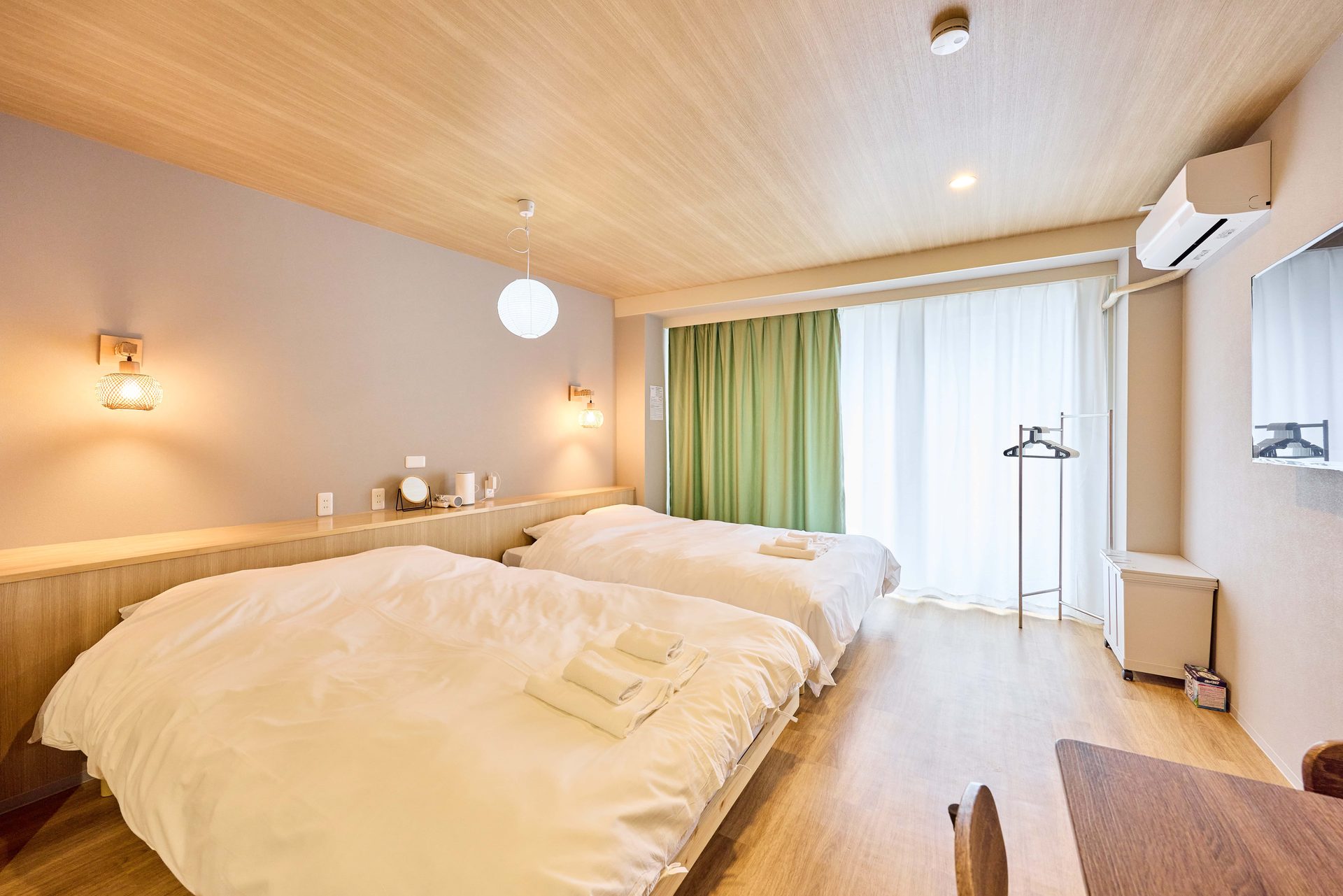
What kind of building is Shinsai Wings?
It's a whole standalone building, steel-frame, newly renovated, and currently in operation. The whole building is this one property — every bit of it.
This might sound like just a difference in scale, but living in it is a completely different experience. The biggest difference between a whole standalone building and a single hotel room is what actually separates you from other people. In a hotel, a wall separates you from the room next door; in shared-room lodging, a hallway, a shared bathroom, and a shared kitchen separate you from other guests. Here, every room type is a fully independent living unit of its own — once your unit's door is closed, what happens inside is entirely your own business.
Structurally, the building is steel-frame construction. In Japan's residential market, a steel-frame standalone building at this scale isn't a common property type in itself — most residential neighborhoods are wood-frame or light-steel-frame townhouses, and anything larger usually falls into the apartment-building category. This building happens to sit in that uncommon middle ground: the scale of an apartment building, used the way a standalone house is used.
Why is each room type a fully independent unit, rather than a single room like a typical minpaku?
Because from the renovation planning stage onward, every room type here was laid out as a complete home, not as a single guest room.
What does that mean in practice? A single guest room needs a bed, a bathroom, and a bit of space for luggage. A complete living unit needs a kitchen you can actually cook a meal in, a dining area you can sit down and eat at, a bathroom you can close the door on and call your own, and somewhere to dry laundry. The former lets you sleep one night; the latter lets you actually live.
This layout is especially noticeable to three kinds of guests:
- Groups traveling together. Each room type has its own private bathroom, so there's no queue when everyone's heading out in the morning — one of the most common flashpoints on a group trip.
- Traveling with young children or elderly family. Being able to cook yourselves means baby food, a bland diet, a late-night snack, or something to mix up in the middle of the night, none of which depend on whether a shop happens to be open.
- Staying more days. Eating out every day works for three days, not for thirty. With a kitchen and dining area, the whole cost structure of a longer stay changes.
On the other hand, if all you need this trip is a clean bed for one night, this setup is really overkill for you. We don't think this is the right choice for everyone — being upfront about that matters more to us than trying to get everyone to book.
What does each room type actually have?
All four bookable room types — A, B, C and D — each have a private bathroom (with a bathtub), a full kitchen, and a private dining area. The difference is in the balcony and the tatami. This table is organized by room type:
| Room type | Private bathroom & bathtub | Full kitchen | Balcony | Tatami bedroom |
|---|---|---|---|---|
| Room A | ✅ Private bathroom, with bathtub | ✅ Yes | — | ✅ Yes |
| Room B | ✅ Private bathroom, with bathtub | ✅ Yes | ✅ Yes | — |
| Room C | ✅ Private bathroom, with bathtub | ✅ Yes | ✅ Yes | — |
| Room D (loft, multi-level layout) | ✅ Private bathroom, with bathtub | ✅ Yes (lower level) | ✅ Yes | ✅ Yes |
Three things in this table are worth a further note, since they're the most commonly misunderstood:
- Balcony comes with Room B, C and D. This is the actual building layout. If you want to dry laundry within your own room, request one of these three room types.
- Tatami bedroom comes with Room A and Room D only. A lot of listings online write "Japanese-style room" as a whole-property feature — we spell it out room by room instead. If you specifically want to sleep on tatami, the room type has to be requested upfront. To see what actually living in a tatami room is like, see "Osaka Tatami Room Stays."
- Room D is a loft. It's a single multi-level layout used by one group of guests, with the kitchen on the lower level.
Whole house up to 16 guests. For bed types and count, tell us your group makeup — how many adults, how many children and their ages — and we'll arrange based on room availability at the time. For exactly how to ask and how rooms get assigned, see "Booking FAQ."
To see exactly what each room type looks like, the website has room-by-room video walkthroughs — nothing describes it as accurately as seeing it directly.
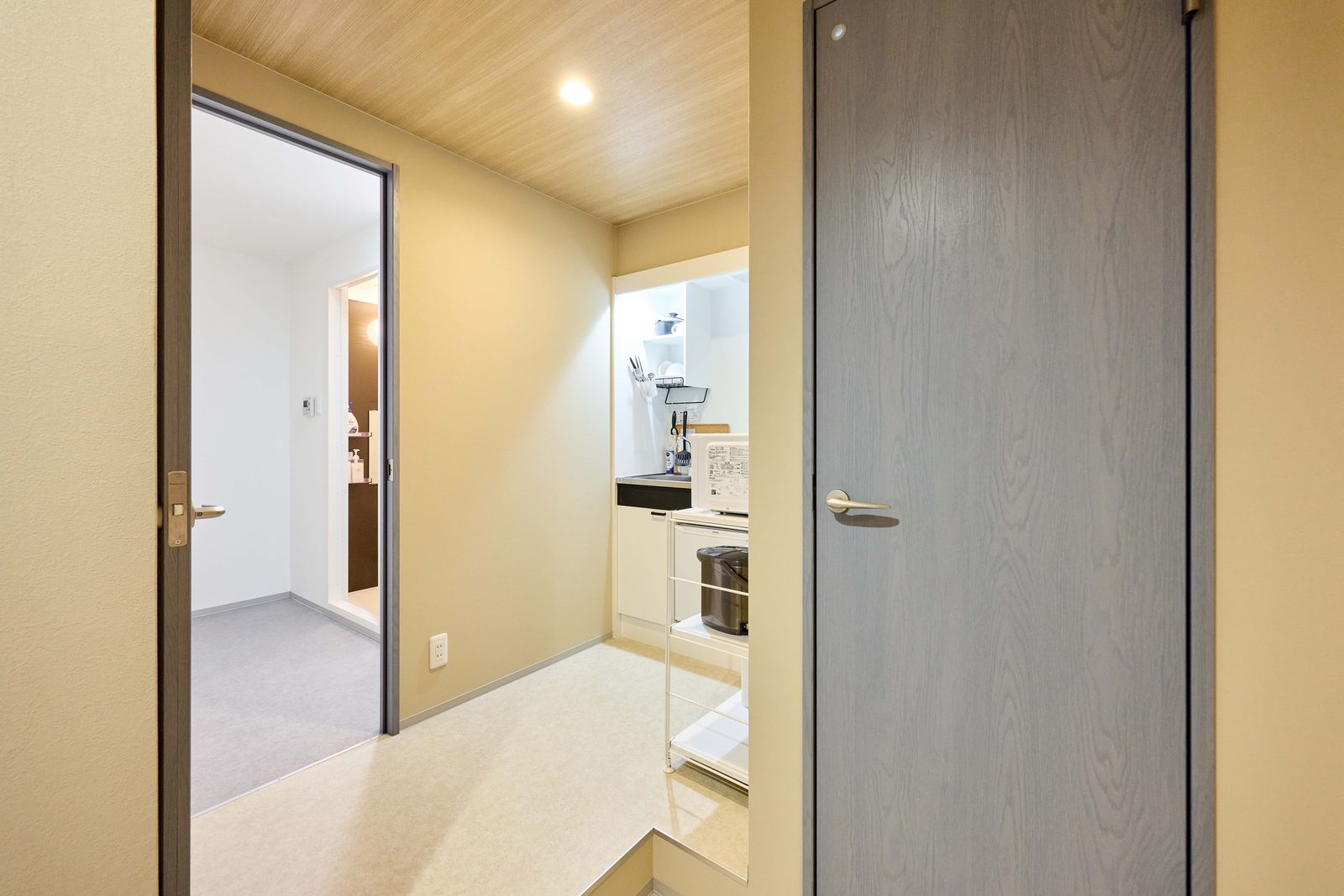
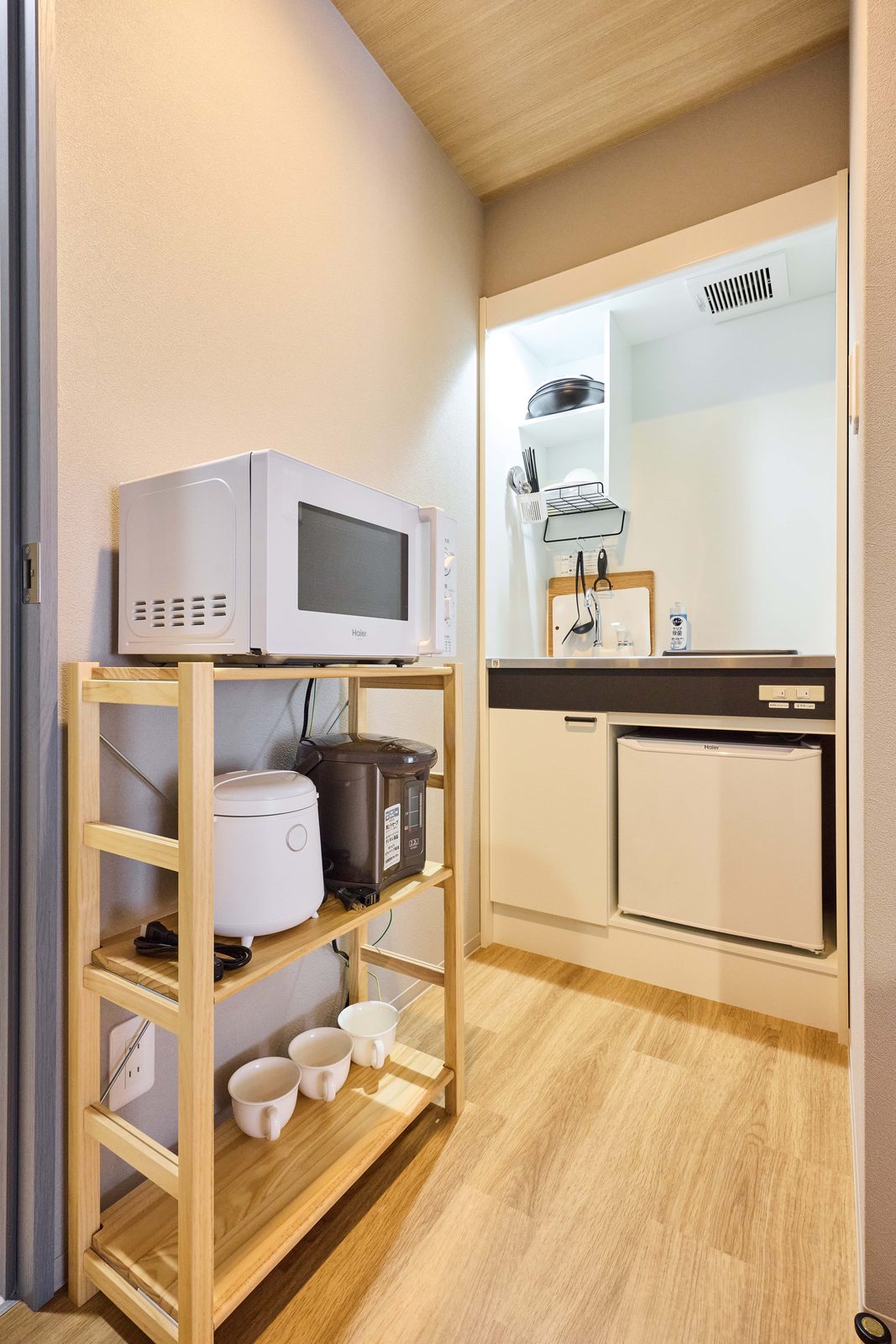
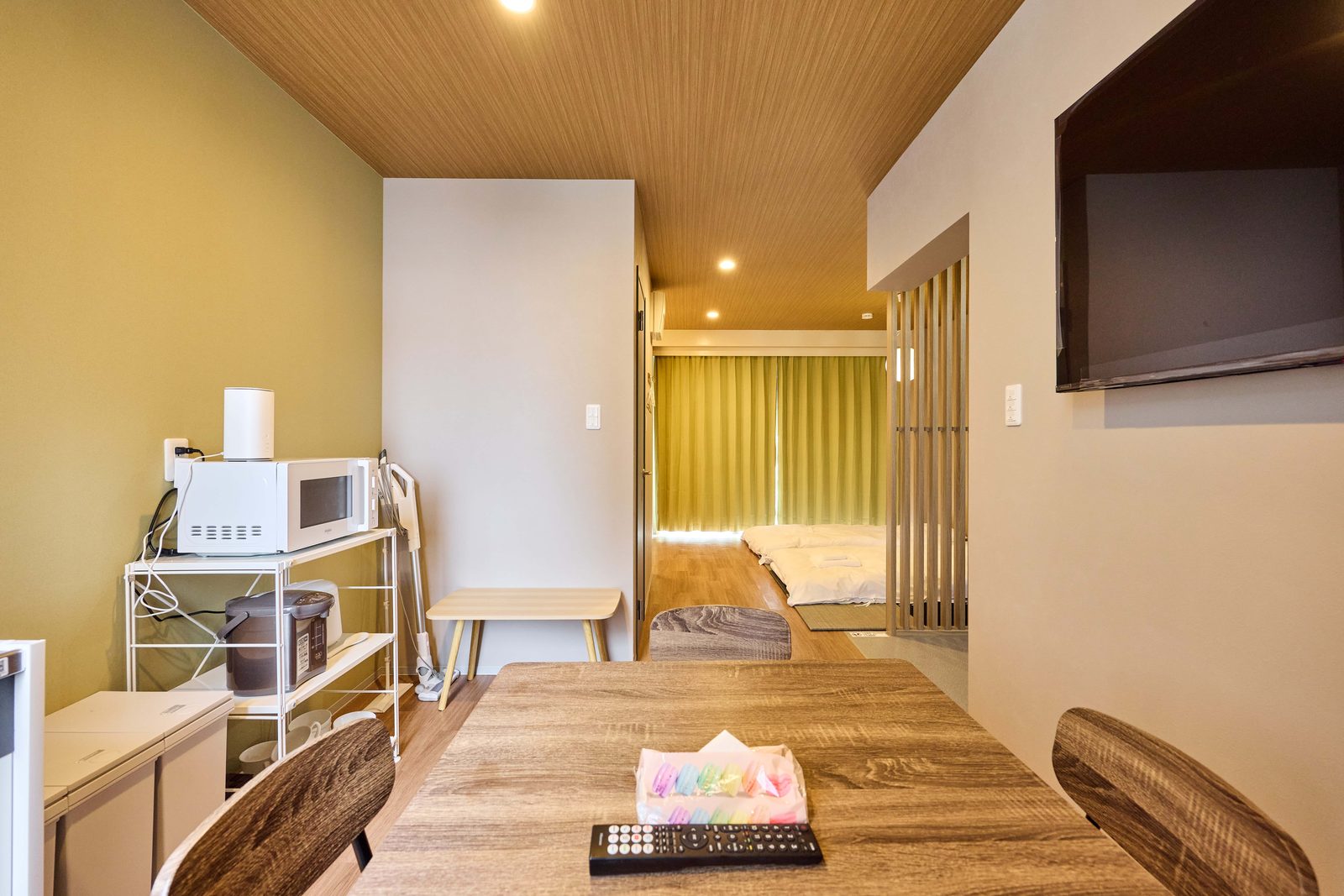
Why does this building operate under two different minpaku licensing systems at once?
Because minpaku in Japan isn't governed by just one system, and different room types in this building fall under different ones. This directly affects which room type can be booked on which dates, so we lay it out plainly rather than gloss over it.
First, the systems themselves. In Osaka, there are at least two common paths for this type of accommodation:
- Special-zone minpaku (National Strategic Special Zone Foreign Visitor Lodging Business). Certified by Osaka City under Osaka City Ordinance No. 3; one of its features is a minimum stay requirement of 3 days (2 nights) or more — a stay of just 1 night isn't possible. (Osaka City, "On the Minimum Stay for Special-Zone Minpaku")
- Regular minpaku (the Private Lodging Business Act, commonly called the Minpaku Shinpo). The Japan Tourism Agency (under MLIT) states that the annual cap on days provided is 180 days, and the "year" here isn't the calendar year — it runs from noon on April 1 to noon the following April 1. (Japan Tourism Agency, "What Is the Private Lodging Business Act (Minpaku Shinpo)?")
Mapped onto this building:
- Room B, C and D are certified under Osaka's special-zone minpaku rule and can operate year-round under a licensed management company.
- Room A is a regular minpaku (Private Lodging Business Act), so it has an annual cap of 180 nights. That means Room A's available dates differ from Room B, C and D's; year-round operation applies to Room B, C and D under the special-zone minpaku rule.
One more piece of objective regulatory background: Osaka City has announced that new applications for special-zone minpaku certification will close on May 29, 2026 (Reiwa 8), and states that "special-zone minpaku facilities already certified before that date may continue operating under the existing rules" (Osaka City, "On the Closing of New Special-Zone Minpaku Applications"). We include this because it's part of understanding the current state of Osaka's accommodation licensing system, not to push you toward booking sooner — this page doesn't do that kind of thing.
⚠️ The two regulations above are cited after we directly opened and confirmed the official pages on 2026-08-25. Regulations and administrative procedures can change, so treat the official page's latest announcement as authoritative. Also: what we publish is which law each room type falls under — Room A under the Private Lodging Business Act, Room B, C and D under Osaka's special-zone minpaku certification; for any registration or reference number, treat the competent authority's own registry as authoritative.
Who runs this? What do the host and the management company each handle?
The host is Taiwanese and talks with you directly; Room B, C and D's Airbnb listings are operated under license by a management company. These are two different things, and knowing which is which actually helps you.
| What you can ask the host directly | What the management company handles on the platform |
|---|---|
| Ask anything about the building in Chinese: room layout, what each room offers, your group's situation, how long suits you best | The listing title, description and photos on the Airbnb page |
| Tell us your headcount and needs, and we'll work out which room fits together | Pricing and discount rules on the platform |
| How mid-to-long-term (one month or more) stay terms are arranged | The live availability calendar and minimum-nights shown on the platform |
| Questions about Room A (Room A is handled solely through the official LINE) | Cancellation and refund policy on the platform side |
For the right-hand column, authority sits with the licensed management company, and any change or exception is decided under their own rules. The reason is simple: operating rights for the listing sit with the management company, and having a single point of decision avoids conflicting instructions. So if what you're asking is "is this date available" or "can this price be negotiated," the most accurate answer is always whatever the Airbnb listing page shows at that moment, not anything written on our own website.
So what can the host actually give you? Judgment, not a quote. Tell us how many people, which month, whether there are elderly family members or young children, whether you want to cook, whether you want tatami — we'll tell you in Chinese which room type fits better and what you should know upfront. That's the part a platform page can't do, and it's the reason we exist.
Why is our address only disclosed down to "Sangenya-higashi, Taisho Ward, Osaka City"?
This is a deliberate decision, not a missing field. On the website, on social media, and in any public-facing document, our address is always disclosed only down to "Sangenya-higashi, Taisho Ward, Osaka City" — we don't publish the block, lot or house number.
The reason: a full street address is information a confirmed guest needs, not information the entire internet needs. This building is home to real travelers and long-stay guests, and posting the exact address on a public webpage does nothing for them. Once your booking is confirmed, the full information you need to arrive is of course provided — that's part of the check-in process, not part of our marketing material.
We're also upfront about the cost of this policy, because it has a real one: some third-party listings require a full address to complete registration, and under this policy, we simply can't do that. This is a trade-off we chose deliberately, not an operational oversight. If you can't find us on some other platform, this is usually why.
If you need to confirm roughly where we are, you can check the coordinates directly on Google Maps, or see "Taisho Station Area Guide" to understand what kind of neighborhood this is.
Which numbers have a source? What should you go by for everything else?
This site only publishes numbers we've verified; for everything else, this section tells you item by item what to treat as authoritative instead. This might be the least marketing-sounding section on the whole site, but it's what determines whether everything above is worth trusting.
| Item | What to go by |
|---|---|
| Floor area figures for the building or room types (in any unit) | This site lists these as unverified — confirm any number with the host via the official LINE before booking; room size can otherwise be judged from the layout, equipment list, photos and videos we publish here. A proxy phrase like "how many suitcases fit flat" is likewise listed as unverified here — phrasing the same unsourced claim differently doesn't give it a source. |
| How many minutes it is from the property to JR Taisho Station | The transit information we publish is the nearest station, route, number of transfers, ride time and fare; for the walking route from the station to our door, go by a map app's live result — it calculates based on your actual location, more accurately than any number fixed on a webpage. |
| How many guests can stay in a single room type | The only guest number we publish is the verified one: whole house up to 16 guests. For how many can stay in an individual room type, tell the host your headcount and who's traveling together, and we'll arrange based on the actual situation. |
| Room rates and monthly rent | Nightly rates are whatever the Airbnb listing page shows at the time; mid-to-long-term rent varies by month, room type and length of stay — see the full monthly rent table on "Osaka Long Stay Overview." |
| Notification number / registration number | Go by the competent authority's own registry; the licensing information we publish is the operating category and Room A's annual cap of 180 nights. |
| Our current booking status | Go by the Airbnb listing page's calendar and the official LINE's reply at the time. What this site discusses is Osaka's seasonal travel patterns; booking status itself always follows those two live sources above. |
Two more things follow the same principle: the host's full personal background, and the timeline from acquiring the building to finishing renovation. What we publish is limited to what has documented support; for either of these, ask the host directly via the official LINE. "We only publish what has a source" is a rule on this site, not a polite gesture.
Where can you actually get to from Shinsai Wings?
The nearest station is JR Taisho, served at the same station by both the JR Osaka Loop Line and the Osaka Metro Nagahori Tsurumi-ryokuchi Line. The two lines serve completely different purposes, and that's where this location's real value lies.
| Destination | How to get there | Transfers |
|---|---|---|
| Shinsaibashi | Osaka Metro Nagahori Tsurumi-ryokuchi Line, direct from Taisho Station, 4 stops, about 6 minutes, ¥190 (Taisho is the terminus of this line, so you board at the start) | 0 |
| Universal Studios Japan (USJ) | JR Osaka Loop Line to Nishikujo, transfer to the JR Yumesaki Line (Sakurajima Line) to Universal-City Station, about 18-22 minutes depending on the train, ¥200 | 1 (Nishikujo) |
| Kyocera Dome Osaka | Kyocera Dome and our building sit on opposite sides of JR Taisho Station; the Osaka Metro Nagahori Tsurumi-ryokuchi Line reaches Dome-mae Chiyozaki Station 1 stop from Taisho. For the actual route, go by a map or transit app's live result | Per map lookup |
| Osaka Station / Umeda / Tennoji | JR Osaka Loop Line, ride to the end in either direction | 0 |
| Kansai International Airport | Via the JR network, the lowest-fare route found at the time of checking was ¥1,060, about an hour or so; the number of transfers varies by time of day (0 to 1 transfers both occur) | 0-1 (varies by time of day) |
※ The figures in the table above are taken from actual results on public transit-search services (Shinsaibashi and USJ checked 2026-08-16 to 08-23; Kansai Airport re-checked on 2026-08-24 across different times of day on Ekitan and Yahoo! Transit). ⚠️ Schedules, times and fares can change — before you travel, go by JR West, Osaka Metro's official information, or a transit app's same-day result; this page provides the actual results and sources as of the day we checked.
Two things in this table are worth clarifying:
- Universal Studios: 1 transfer at Nishikujo. The whole trip is about 18-22 minutes, ¥200. The time is written as a range because it varies by train — fixing it to a single number would itself be a false precision. See "USJ Stay Recommendations" for more.
- Kyocera Dome: what we provide here is the relative location and the train route. The Dome sits on the opposite side of JR Taisho Station from our building; the Osaka Metro Nagahori Tsurumi-ryokuchi Line reaches Dome-mae Chiyozaki Station 1 stop from Taisho. For the actual route, go by a map or transit app's live result. See "Kyocera Dome Concert Stay Guide" for the concert-night route.
How does talking directly to the host in Chinese actually work?
Add the official LINE @040fyjwd, ask in Chinese, and the host replies personally. No need to look anything up in Japanese first, no translation layer, and no multiple layers of agents in between.
More practically, it helps to know upfront what kind of question gets you an answer:
- What you can ask: which room type suits our group, which room type has tatami, which room type has a balcony to dry laundry on, whether we can cook for ourselves, how a stay of a month or more is calculated, whether our specific situation is a good fit here.
- What goes by the platform: live availability on a specific date, nightly rates, and the platform's own cancellation policy — these follow whatever the Airbnb listing page shows at the time, and changes or exceptions are decided by the licensed management company under their own rules.
- What we'll spell out clearly ourselves: any unverified number is always listed as unconfirmed; the scope of our service is also spelled out item by item. For example, day-to-day upkeep during your stay is on the guest — cleaning, laundry and changing sheets are all done by you; the washing machine and dryer are equipment available for your own use — that's a different thing from a laundry service.
Messages are answered by the host personally, and the reply time depends on what he's doing at the time — we only publish what we can actually deliver. After you message, please wait for the host's own reply.
What else is on this website?
The website is organized into four sections, each addressing a different stage of the decision. If you're still comparing which area to stay in, start with the guides; if you're already looking at this specific property, start with the videos and FAQ.
- Guides — whole-house stays, family trips, groups, Universal Studios, luggage, transit, tatami — how to choose for different situations. This section mostly answers "how should I stay in Osaka," not just about us.
- Room Videos — shot floor by floor. No amount of written detail beats watching it directly.
- Booking FAQ — check-in/check-out times, minimum stay, payment, cancellation, trash, pets — the answer comes in the first sentence.
- Long Stay — conditions for staying a month or more, address registration (住民登録), and the difference between short-term student stays and monthly stays.
Shinsai Wings — Verified Facts
- Location: Sangenya-higashi, Taisho Ward, Osaka City (disclosed publicly down to this level only, a deliberate privacy policy)
- Standalone building, an uncommon steel-frame structure, newly renovated, currently in operation
- Four room types, each a fully independent whole unit (Room A, B, C and D; Room D is a loft); whole house up to 16 guests (the only guest number published on this site — ask the host about individual room arrangements)
- Private bathroom in every room type, all with a bathtub; every bookable room type has a full kitchen and private dining area
- Balcony comes with Room B, C and D
- Tatami bedroom comes with Room A and Room D only
- Washing machine and dryer available, for guests to use themselves (equipment for guest use; laundry itself is handled by guests)
- 📌 Booking-logistics facts (check-in/check-out times, minimum stay, pets, payment and cancellation) are on "Booking FAQ."
- 📌 Routes, stops and fares to each destination are on "Taisho Station Area Guide."
- Room B, C and D are certified under Osaka's special-zone minpaku rule and can operate year-round under a licensed management company
- Room A is a regular minpaku (Private Lodging Business Act), with an annual cap of 180 nights; year-round operation applies to Room B, C and D under the special-zone minpaku rule. For the notification number, go by the competent authority's own registry
- Run directly by a Taiwanese host, communication entirely in Chinese; official LINE @040fyjwd
Want to confirm which room type suits your group, or have a question this page doesn't cover? Tap "Free help booking your Osaka stay" at the bottom right to message the host directly, official LINE: @040fyjwd, run directly by a Taiwanese host, communication in Chinese with no barrier.